EN
Baby keeps growing
Pregnancy

Baby keeps growing

2 min readWeek 21
Key takeaways
2 min
  • Monitor your baby's developing movements as they become more coordinated and refined during pregnancy progression.
  • Expect 10-15 periods of fetal activity per day alternating with approximately 18 hours of deep sleep.
  • Watch for taste bud formation on your baby's tongue, enabling them to distinguish between different flavors.
  • Understand that twins often differ a little in size; your care team checks both babies' growth on the scans it schedules and will tell you if a difference needs closer monitoring.
  • Observe smoother baby skin development due to subcutaneous fatty tissue accumulation and improved heat retention.

Early pregnancy signs include missed periods, nausea, and breast tenderness. As pregnancy progresses, babies develop coordinated movements, taste buds, and smoother skin from fatty tissue accumulation, with 10-15 daily activity periods alternating with deep sleep phases.

amma app

What is your body telling you?

A personal check-up from amma — answer honestly and get your read-out

Rated 4.8· 417,594 reviews

Baby keeps growing

Due to the accumulation of subcutaneous fatty tissue, the baby’s skin becomes smoother and acquires a soft pink hue, their body is also better at retaining internal heat.

Baby keeps growing - Baby keeps growingAs their brain develops, the baby’s movements become even more refined and coordinated [1]. They can now freely turn over, settling in the uterus, then turn upside down and even completely across.

The baby’s nervous system activity is also developing. Periods of activity — usually 10 to 15 per day — are alternating with deep sleep [2]. During wakefulness, the baby’s heartbeat becomes more frequent, respiratory movements increase and short-term muscle contractions are noticeable. But during deep sleep, which averages about 18 hours a day, activity decreases.

This week, taste buds form on the baby’s tongue, and soon they will be able to distinguish between sweet and salty, sour and bitter [1].

If you are expecting twins

We can say that each of the twins is now the size of an average banana. But children, like bananas, come in different sizes! Almost certainly one of the babies is slightly larger than the other. Your care team checks both babies’ growth on the scans it schedules and will tell you if the difference needs closer monitoring.

What can be seen on ultrasound

The baby is lying on their back and has taken a finger from the left hand to the mouth. Their position indicates that they are calm and comfortable.

The right hand is resting alongside the body, and the palm of the left hand and forearm are visible. The outlines of the head and contour of the forehead are also clear. Along with their tiny mouth and eyes, which are hidden under the eyelids.

Baby keeps growing - Baby keeps growing
  1. head

  2. hand

In the following picture, the baby is lying on their back. The head is turned to the screen, and the outlines of the eye sockets are visible. The small dark oval on the chest is the heart. Below, in the abdominal cavity, we can see the outline of the intestines.

In the image, you can see the baby’s hip, the right leg which is bent at the knee, and the lower leg and left foot with its rounded heel and metatarsal bones. The left arm is bent at the elbow, and the palm reaches out to the ear. The dark outline shown in the photo is amniotic fluid.
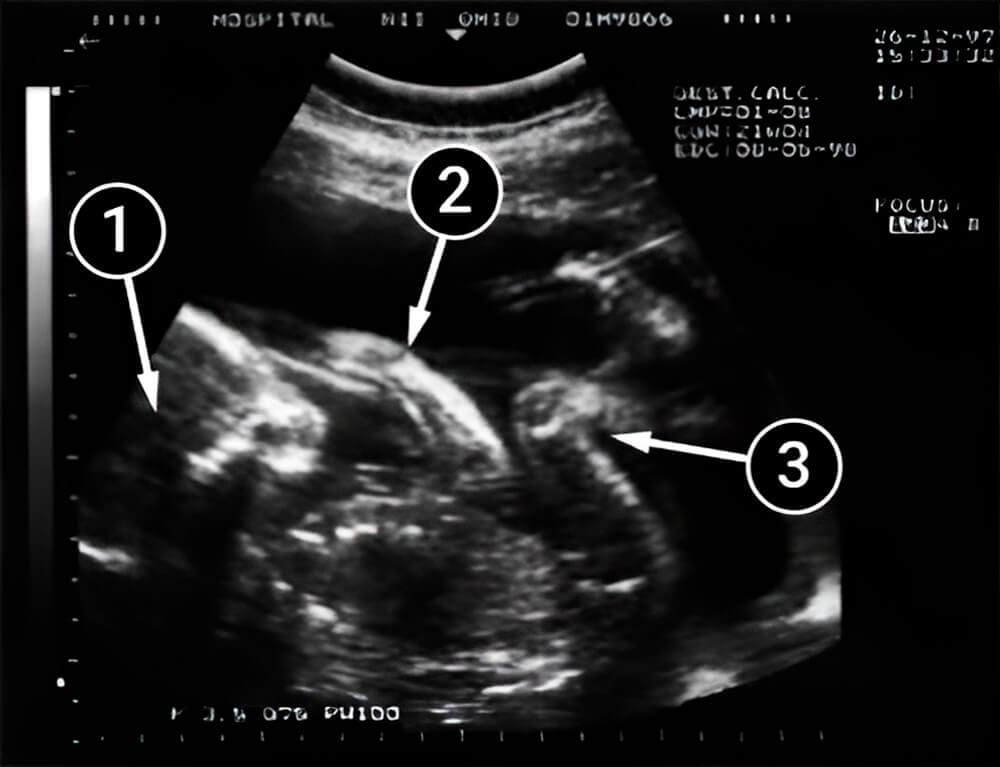
Baby keeps growing - Baby keeps growing
  1. head

  2. hand

  3. legs


Not sure how far along you are?

Convert weeks to months, estimate your due date, and follow week-by-week progress.

Open pregnancy calculators
Frequently asked questions

Early pregnancy signs include missed periods, nausea, breast tenderness, and fatigue. As pregnancy progresses, you'll notice fetal movements and changes in your body that indicate healthy baby development.

Baby movements become noticeable as their nervous system develops. Expect 10-15 periods of daily activity alternating with deep sleep phases averaging 18 hours per day.

Normal development includes coordinated movements, regular sleep-wake cycles, and proper growth visible on ultrasounds. Your baby's skin becomes smoother and they develop taste buds during this time.

A small size difference is common: each baby develops at their own pace, similar to how bananas come in different sizes naturally. A bigger difference can mean one baby isn't growing as well, so your care team checks both babies' growth on the scans it schedules and will tell you if a difference needs closer monitoring.

Medical Disclaimer

This article is for informational purposes only and is not a substitute for professional medical advice, diagnosis, or treatment. Always seek the advice of your physician or qualified health provider with any questions you may have regarding a medical condition.

Meet our medical experts

Medically reviewed content

Reviewed by healthcare professionals · Updated

This article is based on peer-reviewed research and trusted medical sources.

  1. Brewer S. The Pregnant Body Book. Dorling Kindersley Publishing Staff, 2012, pp. 135-136.
  2. Fetal development: The 2nd trimester. Mayo Clinic.
amma app

What is your body telling you?

Get your personal read-out from amma

What is your body telling you?

Trusted by over 30 million women worldwide

Rated 4.8417,594 reviews