Your baby’s brain and higher nervous functions are developing
Your baby’s development is non-stop. Thanks to the accumulation of subcutaneous fat, your baby is becoming plumper with nice rounded cheeks [1].
 The baby's digestive system is already formed, but it will take time for it to function fully. The lungs are not mature enough to work on their own yet; they are likely to be ready to breathe on their own from about 36 weeks [2, 3].
The maturation of the baby’s cerebral cortex and related higher nervous functions continues. An interesting fact is that the baby’s brain grows unevenly, in most babies the left hemisphere is larger than the right in the womb [4, 5].
While the layer of protective lubricant that covers the baby’s body becomes thicker [6], the skin is still very thin and transparent. At this age, the skin remains colorless — and we can see the blood vessels through it. Genetic skin pigmentation will begin in the third trimester. This process will continue after birth, up through the first year of life. But in the womb, all babies tend to look the same, regardless of the skin color of their parents [7].
If you are expecting twins
The babies are now pretty cramped inside the uterus. It's getting harder for them to roll over. Nearer your due date, your doctor will talk to you about how your babies may be born: if the baby nearest your cervix is head down and there are no other complications, you should be able to plan a vaginal birth if you choose, whatever the position of the second baby.
What can be seen on ultrasound
The picture shows the baby’s head. Their nose, ear, and upper and lower jaws are visible. The white arches in the head area are the frontal and occipital bones. You can see the arms bent at the elbows and folded towards the chest. Below you can see the spine, which looks like a white strip. The dark area around the chest is the heart.
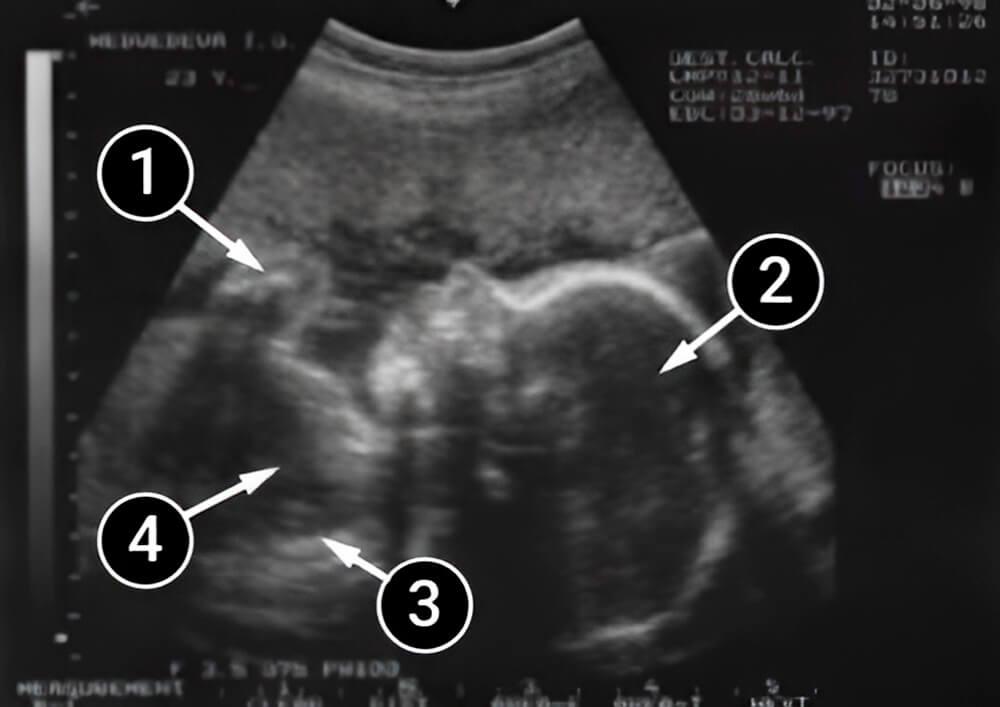
hands
head
spine
heart