EN
Second trimester: what to expect?
Pregnancy

Second trimester: what to expect?

4 min readWeek 15
Key takeaways
4 min
  • Expect rapid weight gain of 300-500 grams per week as your baby, uterus, and blood volume increase significantly during the second trimester.
  • Feel your baby's first movements between weeks 18-20, starting as light bubbling sensations that develop into recognizable kicks and somersaults.
  • Notice your belly growing outward as the uterus expands beyond the pelvic cavity and reaches your navel by mid-trimester.
  • Prepare for new physical changes including the linea nigra (dark abdominal line) and darkening of areolas due to increased hormones.
  • Consider discussing baby's gender determination through ultrasound around week 18-20 or earlier genetic blood testing with your healthcare provider.

The second trimester brings exciting changes including your baby's first movements (weeks 18-20), rapid weight gain of 300-500g weekly, visible belly growth as the uterus expands, and the ability to determine baby's gender through ultrasound around week 18-20.

amma app

What is your body telling you?

A personal check-up from amma — answer honestly and get your read-out

Rated 4.8· 417,594 reviews

One of the most exciting parts of pregnancy begins! Your baby is rapidly growing and your stomach is too! Soon you will feel their first movements. We’ve outlined how things develop, and everything else you can expect in this review.  

Rapid weight gain

From the second trimester on, you will likely gain an average of 300-500 grams per week [1]. The extra weight consists of the weight of the baby, the uterus, and the amniotic fluid. In addition, the volume of circulating blood in your body increases, and by the end of pregnancy, it will be up to one and a half liters more than at the beginning. 

The belly is growing

The uterus has grown to the size of a grapefruit and no longer fits in the pelvic cavity, so your lower abdomen begins to round out [2]. By the middle of the trimester, your uterus will grow to the level of your navel and your pregnancy will become noticeable to others. By the end of the trimester, the baby will occupy most of the abdominal cavity and begin to prop up the chest [3]. Then your belly will start growing forward.   

The baby starts to move

Your baby has actually been waving their arms and legs since the eighth week [4]. But it’s not until weeks 18 to 20 that they are big enough for you to feel their movements [5]. At first, the movements will feel light and occasional, more like a bubbling in the stomach. But by the end of the trimester, you will become an expert on your baby’s movements! You will learn to distinguish kicks from somersaults and may find yourself interacting with them more and more.

Biological sex can be seen on ultrasound

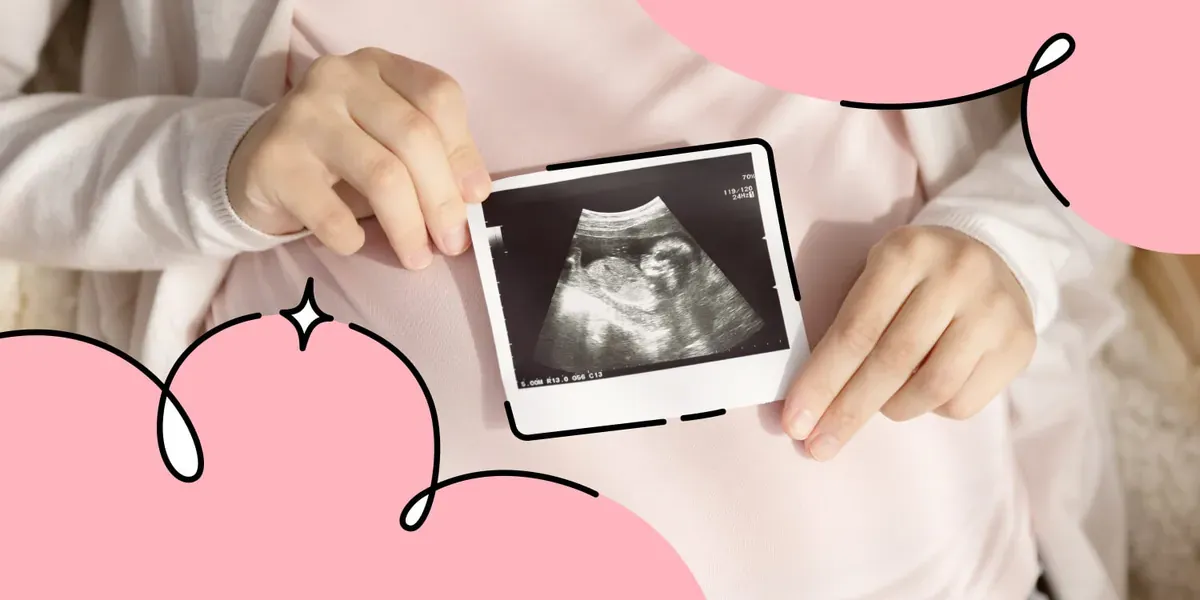
By the beginning of the second trimester, a boy’s penis and a girl’s vulva are formed. In theory, the genitals can be seen on an ultrasound by week 14 [6]. In practice, most parents find out the sex of the child a month and a half later, during the second-trimester screening, and only if they wish to know, of course.

In recent years, many doctors have started offering genetic blood testing, which can identify the baby’s DNA in the mother’s blood, screening for different conditions and determining the baby’s sex [7]. 

A dark stripe appears on the abdomen

This is a well known characteristic of pregnancy, but may be more or less noticeable depending on your skin tone. Known as the linea nigra, this pigmented line appears from the pubic bone to the navel as a consequence of an increase in hormones and melanin. This extra pigmentation can accumulate in some areas, including the belly. The areolas around the nipples, the skin around the mouth and nose, and the inner thighs can also darken [8]. After childbirth, this pigmentation will disappear on its own.

New symptoms appear

The second trimester is usually considered the most enjoyable period of pregnancy. Nausea and drowsiness are left behind, and the challenges of the final weeks are relatively far ahead [9]. Still, you can expect to experience a few new symptoms. Here’s what most expectant mothers report during the second trimester:

  • Growing pains. They feel like a sharp spasm on one side of the abdomen and tend to subside when you change position. The pain is caused by the stretching of the muscles and ligaments, which are working to accommodate a rapidly growing uterus [10].

  • Stuffy nose. Under the influence of the hormone progesterone, the mucous membranes swell and it may become difficult to breathe. Ask your doctor to prescribe safe nasal drops and rinse your nose with saline solution if you need to [11].

  • Constipation. Hormonal changes can slow down digestion, hence the unpleasant irregularity common during pregnancy. The standard action [12].


Not sure how far along you are?

Convert weeks to months, estimate your due date, and follow week-by-week progress.

Open pregnancy calculators
Frequently asked questions

Most women feel their baby's first movements between weeks 18-20 of the second trimester. Initially, these movements feel like light bubbling or fluttering in your stomach before developing into more recognizable kicks and rolls.

During the second trimester, you'll typically gain 300-500 grams (0.7-1.1 pounds) per week on average. This weight includes your growing baby, enlarged uterus, amniotic fluid, and increased blood volume.

Baby's biological sex can theoretically be seen on ultrasound by week 14, but most parents learn the gender around weeks 18-20 during the second-trimester screening. Some doctors also offer genetic blood testing for earlier gender determination.

The dark line is called linea nigra, appearing from the pubic bone to navel due to increased hormones and melanin during pregnancy. This pigmentation is completely normal and will disappear naturally after childbirth.

Yes, the second trimester is generally considered the most comfortable period of pregnancy. Morning sickness and fatigue typically subside, while the physical challenges of late pregnancy haven't yet begun.

Medical Disclaimer

This article is for informational purposes only and is not a substitute for professional medical advice, diagnosis, or treatment. Always seek the advice of your physician or qualified health provider with any questions you may have regarding a medical condition.

Meet our medical experts

Medically reviewed content

Reviewed by healthcare professionals · Updated August 15, 2025

You might also like

Postpartum hemorrhage: What to expect, and when to seek helpPregnancy 2 min

Postpartum hemorrhage: What to expect, and when to seek help

Learn to identify dangerous postpartum hemorrhage vs normal lochia after pregnancy and birth. Know the warning signs and when to seek emergency help immediately.

postpartum-symptomssymptoms
Second trimester extra ultrasoundsPregnancy 2 min

Second trimester extra ultrasounds

Learn why doctors order additional ultrasounds during second trimester and what they're checking. Get expert insights on Doppler scans, safety concerns, and when to worry.

doctor-visits
Postpartum hemorrhage: What to expect, and when to seek helpNew Parent 2 min

Postpartum hemorrhage: What to expect, and when to seek help

Learn to recognize dangerous postpartum hemorrhage vs normal lochia bleeding after delivery. Know warning signs, when to seek help, and treatment options. Get expert guidance.

postpartum-symptomslabor-and-delivery
Are you drinking enough water?Pregnancy 3 min

Are you drinking enough water?

Learn essential hydration tips for a healthy pregnancy. Discover how much water pregnant women need, what beverages to avoid, and why proper hydration matters for you and baby.

nutritionsymptoms
You can exercise againPregnancy 1 min

You can exercise again

Learn when it's safe to exercise after pregnancy and how to gradually return to your fitness routine. Get expert tips for new moms starting at 12 weeks postpartum.

fitnesspostpartum-symptoms
Anesthesia during childbirth: What you need to knowPregnancy 3 min

Anesthesia during childbirth: What you need to know

Learn about epidurals, IV pain medications, and natural methods for childbirth pain relief. Discover safe anesthesia options for your healthy pregnancy journey.

unfpalabor-and-delivery
amma app

What is your body telling you?

Get your personal read-out from amma

What is your body telling you?

Rated 4.8417,594 reviews