EN
try amma today
Gestational age and ultrasound data
Pregnancy

Gestational age and ultrasound data

3 min readWeek 35
Key takeaways
3 min
  • Trust first trimester ultrasounds over later scans for determining your baby's due date and gestational age accuracy.
  • Understand that second and third trimester ultrasounds can overestimate gestational age due to individual baby growth variations.
  • Consider multiple factors including genetics, maternal health, and baby's gender when interpreting ultrasound dating discrepancies.
  • Request follow-up ultrasounds 2-3 weeks apart if there's significant discrepancy between last menstrual period and late ultrasound dates.
  • Know that maternal age affects dating accuracy, with mothers 20-24 having the most discrepancies between period and ultrasound dates.

First trimester ultrasounds are most accurate for determining gestational age and due dates because embryos develop at consistent rates. Later ultrasounds can overestimate age due to individual growth variations, genetics, and maternal factors like diabetes or obesity.

amma app

Track week 35 in the amma app

Personalized daily updates for your pregnancy

Rated 4.8· 417,594 reviews
Download App

Ultrasound technology is hugely helpful in discovering lots of information about baby and the pregnancy. However, it’s not perfect. One instance where it can be a little off is in determining gestational age and baby’s due date. Most of us know that we can’t expect baby to be born exactly on his due date. Here, we cover some examples of when ultrasound has discrepancies.

I had an ultrasound in my first and second trimesters, and they don’t line up in determining my baby’s gestational age. Which one is right?

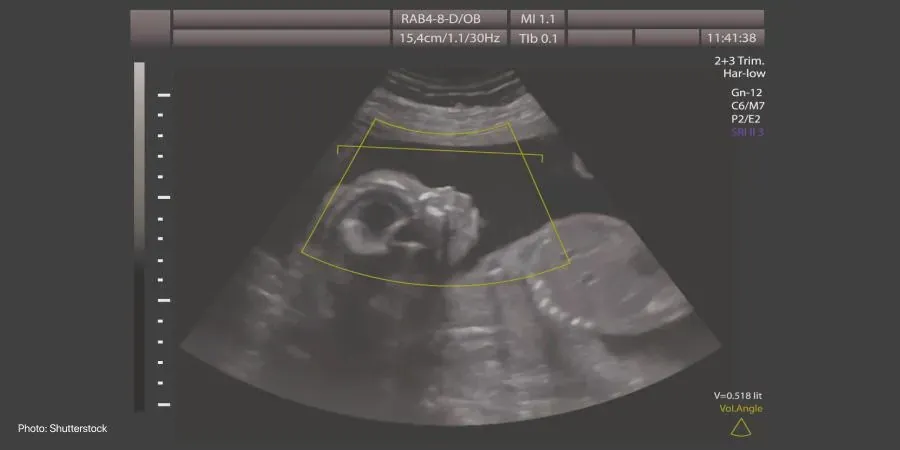
The ultrasound in the first trimester is more likely to be correct. Human embryos develop at more or less the same rate, but in the second trimester, when baby’s organ systems are formed, babies can grow differently according to genetics and environmental factors. Your doctor uses baby’s head, abdominal, and hip measurements to determine gestational age, but in the second trimester, healthy babies at the same gestational age can be larger or smaller than average [1].

Furthermore, if the expectant mama is obese or has gestational diabetes, a later ultrasound almost always overestimates baby’s gestational age because of baby’s size. And statistically, baby girls are more likely to have their age overestimated than baby boys [2].

Lastly, ultrasound equipment doesn’t yield perfect images. If there is an earlier ultrasound, it’s usually the one used to determine baby’s gestational age and due date [1].

I didn’t have a first trimester ultrasound. Should I rely on my current ultrasound to determine baby’s due date, or should I go by the date of my last period?

When faced with uncertainty, the more information, the better! It’s not considered very reliable to guess baby’s due date by the date of your last period, especially if that was six or more months ago. But the late ultrasound isn’t necessarily much better, since various factors can influence baby’s size. In this case, your doctor may opt to track baby’s growth rate by having you come in for another ultrasound in two or three weeks [1]. Your doctor will also assess genetic factors that could influence baby’s growth. As an example, a baby with two tall parents is likely to have longer legs.

Your age also matters. Statistically, the biggest discrepancies between the due date determined by last period and the due date determined by ultrasound happen for mothers aged 20-24. Expectant mamas aged 30 and older have much less discrepancy between the two [2].

I had my first trimester ultrasound, and my doctor said baby is “older” than his gestational age. What does that mean?

It’s best to ask your doctor to clarify. Most likely, baby is larger than average for his age, or the placenta shows more development than is expected for your stage of pregnancy.


Not sure how far along you are?

Convert weeks to months, estimate your due date, and follow week-by-week progress.

Open pregnancy calculators
Frequently asked questions

First trimester ultrasounds are most accurate for determining due dates and gestational age. Human embryos develop at similar rates early in pregnancy, making measurements more reliable than later scans.

Second trimester babies grow at different rates based on genetics and environmental factors. Later ultrasounds often overestimate gestational age, especially if the mother has gestational diabetes or obesity.

Early ultrasounds are generally more reliable than last menstrual period calculations. If you only have a late ultrasound, your doctor may recommend tracking growth with follow-up scans.

This typically means your baby is larger than average for their gestational age. It could indicate accelerated growth or more advanced placental development than expected.

Medical Disclaimer

This article is for informational purposes only and is not a substitute for professional medical advice, diagnosis, or treatment. Always seek the advice of your physician or qualified health provider with any questions you may have regarding a medical condition.

Meet our medical experts

Medically reviewed content

Reviewed by healthcare professionals · Updated March 25, 2025

You might also like

How do you calculate the age of a premature baby?New Parent 2 min

How do you calculate the age of a premature baby?

Learn how to calculate your premature baby's chronological and adjusted age. Essential guide for tracking milestones, feeding, and development. Get expert tips now!

baby-caremedical-tests
An ultrasound can now reveal the baby’s sexPregnancy 2 min

An ultrasound can now reveal the baby’s sex

Discover when ultrasounds can reveal your baby's gender and what to expect during fetal development. Learn about anatomy formation and twin pregnancy differences.

medical-tests
An ultrasound can now reveal your baby’s sexPregnancy 2 min

An ultrasound can now reveal your baby’s sex

Discover when ultrasound can reveal your baby's gender and start exploring baby names! Learn about fetal development milestones and twin pregnancy differences.

doctor-visitsmedical-tests
You can hear your baby's heartbeat without an ultrasoundPregnancy 2 min

You can hear your baby's heartbeat without an ultrasound

Discover early signs of pregnancy including when you can hear your baby's heartbeat without ultrasound. Learn key fetal development milestones. Get expert pregnancy guidance.

symptomsmedical-tests
What is pelvic floor dysfunction?Pregnancy 1 min

What is pelvic floor dysfunction?

Learn pelvic floor dysfunction signs like urine leakage during healthy pregnancy. Discover prevention tips, Kegel exercises, and treatments. Get expert advice.

fitnesslabor-and-delivery
Smile! Sharing your brand new baby with the worldPregnancy 2 min

Smile! Sharing your brand new baby with the world

Discover tips for capturing perfect first photos with your newborn while choosing meaningful baby names. Get practical advice for new parents on postpartum preparation and baby essentials. Start planning today!

postpartum-symptomsshopping
amma app

Download amma

#1 Pregnancy App

Open in App

Track your pregnancy on the go

Rated 4.8417,594 reviews