EN
The return of your period
New Parent

The return of your period

2 min readWeek 10
Key takeaways
2 min
  • Expect your period to return around 9 weeks postpartum on average, though breastfeeding can delay it up to 36 weeks.
  • Use any menstrual products you prefer once your period returns, as your cervix will be sufficiently closed.
  • Understand that your cervix will remain slightly more open than before pregnancy, which is completely normal.
  • Consider using pH 4.5 water-based lubricants if experiencing vaginal dryness from breastfeeding-related low estrogen.
  • Avoid breast stimulation during intimacy if you're trying to stop milk production after weaning.

Your period typically returns around 9 weeks after a healthy pregnancy and birth. Non-breastfeeding mothers may see earlier return, while exclusively breastfeeding mothers may not menstruate for up to 36 weeks due to hormonal changes.

amma app

What is your body telling you?

A personal check-up from amma — answer honestly and get your read-out

Rated 4.8· 417,594 reviews

The return of your period

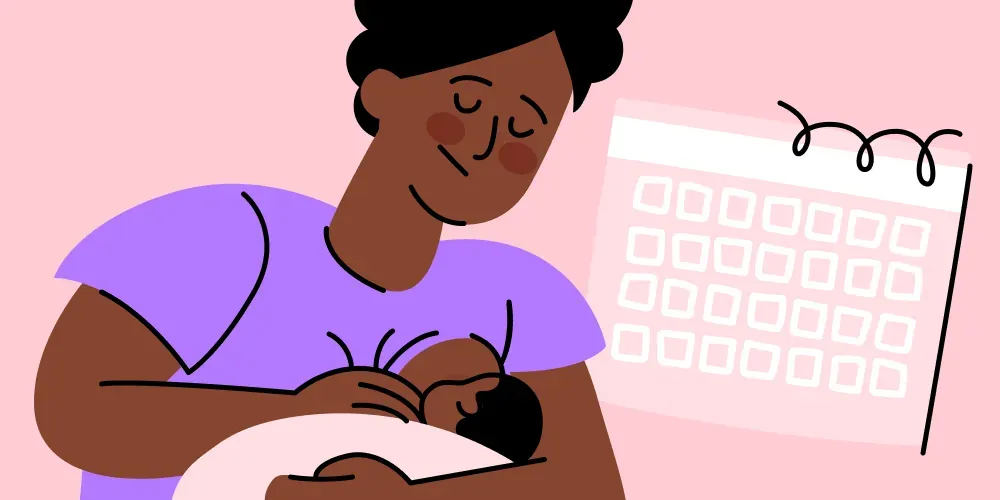
Nine weeks postpartum is the average time for women to start their period again. But it’s not exact: if you are not breastfeeding, your period may start earlier; if you are breastfeeding on demand, it may start later. Half of nursing mothers don’t start menstruation for almost 36 weeks (that is, almost as long as pregnancy itself) [1].

If your period has begun, you can use tampons or whatever products you prefer. The cervix is ​​almost closed, but will never return to the state as it was before the birth. Postpartum the cervix will always be less tightly closed than that of a woman who has not given birth [1].

The vaginal mucosa is restored by this time in those who are not breastfeeding. Vaginal dryness may persist in lactating mothers due to low estrogen levels [1]. Therefore, the thought of sex may not seem very comfortable. Water-based intimate lubricants can be used. Their pH should be 4.5 [2]. If you decide to stop breastfeeding, you may want to curb any breast stimulation during sex, otherwise milk production may continue.



Frequently asked questions

Most women get their period back around 9 weeks postpartum. However, if you're breastfeeding exclusively, it may take up to 36 weeks for your period to return.

Yes, you can safely use tampons or any menstrual products you prefer once your period returns. Your cervix will be sufficiently closed by this time.

Vaginal dryness is common in breastfeeding mothers due to low estrogen levels. This typically resolves once you stop breastfeeding or your hormones stabilize.

Yes, breastfeeding on demand can significantly delay your period's return. Half of nursing mothers don't menstruate for almost 36 weeks postpartum.

Your cervix will close almost completely but remains slightly more open than before pregnancy. This permanent change is normal and doesn't affect your health.

Medical Disclaimer

This article is for informational purposes only and is not a substitute for professional medical advice, diagnosis, or treatment. Always seek the advice of your physician or qualified health provider with any questions you may have regarding a medical condition.

Meet our medical experts

Medically reviewed content

Reviewed by healthcare professionals · Updated

You might also like

The critical development period endsPregnancy 2 min

The critical development period ends

Learn why your healthy pregnancy gets easier after the critical development period ends. Discover common symptoms like constipation and heartburn plus twin pregnancy tips.

parenting
The postpartum period is overPregnancy 1 min

The postpartum period is over

Learn when the postpartum period officially ends and how to maintain a healthy pregnancy recovery. Get expert tips on nutrition, weight loss, and sleep. Start your journey today!

postpartum-symptomsemotions
Caring for your baby during those first daysPregnancy 3 min

Caring for your baby during those first days

Essential newborn care tips for your healthy pregnancy journey. Learn proper dressing, bathing, diapering, and umbilical cord care for baby's first days. Get expert advice now.

postpartum-symptomsnewborn-care
My period's isn’t back yet. Is that normal?New Parent 1 min

My period's isn’t back yet. Is that normal?

Learn when ovulation and periods return after childbirth. Breastfeeding affects timing - use our ovulation calculator to track your cycle when it returns.

breastfeeding
How to eat to prevent complications during pregnancyPregnancy 2 min

How to eat to prevent complications during pregnancy

Discover evidence-based nutrition strategies for a healthy pregnancy. Learn how the DASH diet can reduce gestational diabetes and preeclampsia risks by up to 50%. Start eating right today!

nutrition
Screening during the second trimester: what doctors look forPregnancy 1 min

Screening during the second trimester: what doctors look for

Learn what doctors screen for during second trimester ultrasounds at 18-21 weeks, including baby development, placenta health, and potential risks. Get prepared today!

medical-testspartnerdoctor-visits
amma app

How is your body doing?

Get your personal read-out from amma

What is your body telling you?

Trusted by over 30 million women worldwide

Rated 4.8417,594 reviews