EN
try amma today
Sleep quality improves
Getting Pregnant

Sleep quality improves

2 min readWeek 13
Key takeaways
2 min
  • Expect sleep quality to improve around 3 months postpartum, even if total sleep hours remain limited during your healthy pregnancy recovery period.
  • Prioritize daytime naps whenever possible, as sleep deprivation increases risk of childhood injuries and affects parental coordination and reaction time.
  • Recognize that difficulty falling asleep despite having time may indicate postpartum depression and should be discussed with your healthcare provider.
  • Take advantage of breastfeeding benefits, as studies show nursing mothers experience more noticeable improvements in sleep quality by 12 weeks.
  • Follow the 'sleep when baby sleeps' advice starting around 3 months when it becomes more practical and achievable for most new parents.

Sleep quality typically improves around 3 months postpartum during healthy pregnancy recovery, particularly for breastfeeding mothers. While total sleep hours may remain limited, many parents find it easier to fall asleep and experience better rest quality by 12 weeks.

amma app

Track your pregnancy in the app

Personalized content for your pregnancy week

Download App

Sleep quality improves

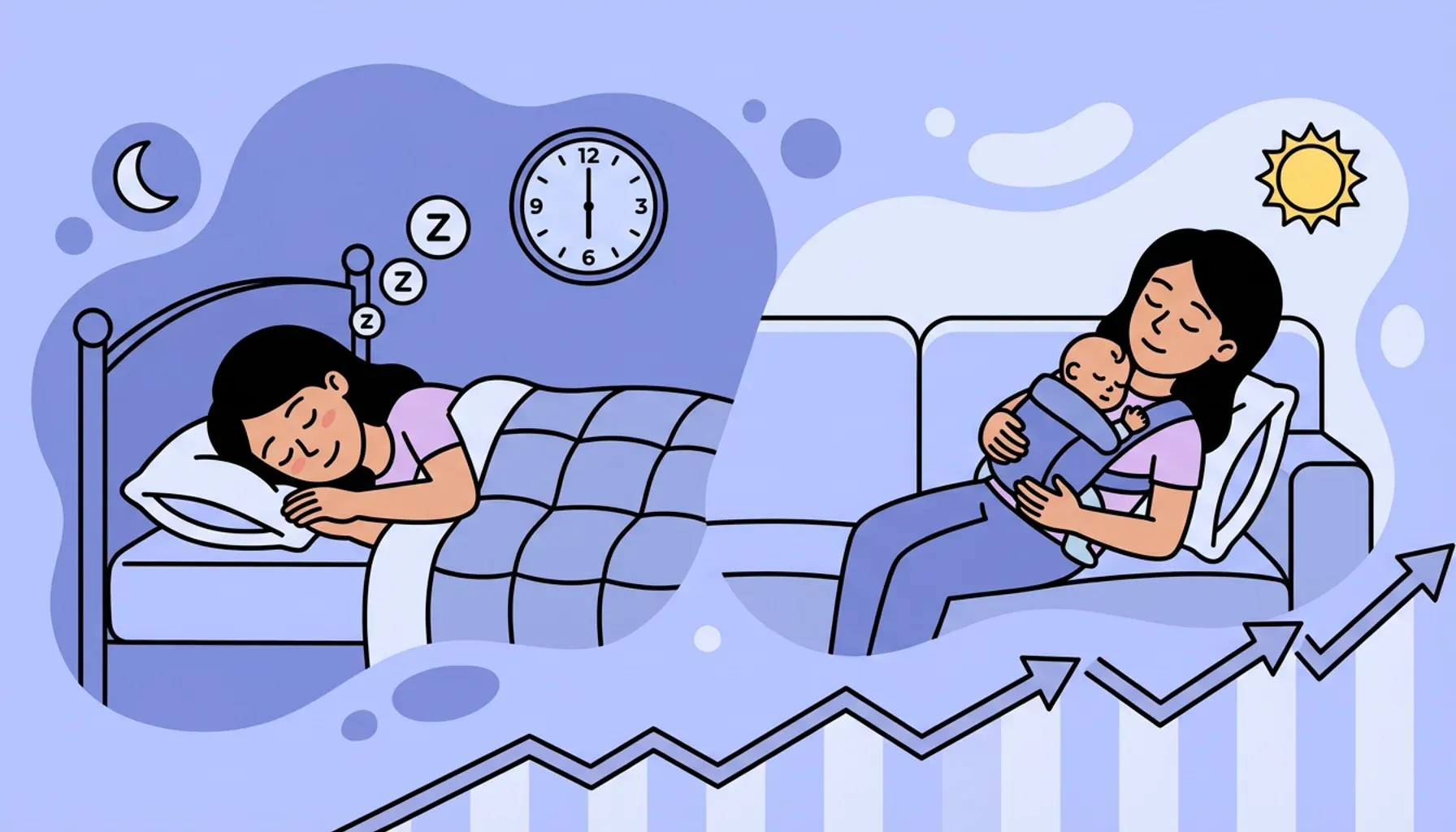
Three months after giving birth, your body has generally recovered. The lochia stopped, lactation improved, pain has retreated, even the strength for exercising has returned. But most parents will not be able to get enough sleep yet.

According to surveys conducted in the UK, 60% of new parents sleep no more than 3.5 hours at night during the first two years after the birth [1]. This is not enough.

Try to get at least some sleep during the day. This is important not only for your well-being, but also for your baby’s safety. Parental sleep deprivation is one of the causes of early childhood trauma [2]: accumulated fatigue leads to decreased concentration, coordination of movements, and reaction speed.

Moreover, sleep deprivation and postpartum depression (in both parents) are related illnesses. And it is not always easy to establish which one is primary. If a woman has time, but cannot fall asleep, this should already be considered as one of the signs of depression [3].

But there is good news: by the age of three months, many mamas see an improvement. If not the quantity, then the quality of sleep. Moreover, studies show that positive changes are more noticeable in women who breastfeed [3]. It is not yet clear whether this can be explained by hormonal or psychological reasons.

Many mamas also find it easier to fall asleep by the 12th week [3]. If earlier the advice “Sleep when the baby sleeps” was impossible for you, perhaps now it will start to work. Take advantage of the moment!


  1. New Parents Have 6 Months Sleep Deficit During First 24 Months of Baby’s Life. Christian Nordqvist. Medical News Today, 2010.

  2. Association between Sleep Deprivation in Caregivers and Risk of Injury among Toddlers: A Propensity Score Analysis. I-Tsung Chiu, et al. BioMed Research International, Jun 2020.

  3. Sleep and Depression in Postpartum Women: a Population-Based Study. Dørheim, Signe Karen, et al. Sleep, 2009.

Frequently asked questions

Most mothers notice sleep quality improvements around 3 months postpartum, even though total sleep duration may still be limited. Breastfeeding mothers tend to experience more noticeable positive changes in sleep quality by this time.

According to UK surveys, 60% of new parents sleep no more than 3.5 hours at night during the first two years after birth. This insufficient sleep affects concentration, coordination, and reaction speed.

Yes, sleep deprivation and postpartum depression are related conditions in both parents. If you have time to sleep but cannot fall asleep, this may be a sign of depression requiring medical attention.

Proper sleep is crucial for both parental well-being and baby safety. Sleep deprivation is linked to increased risk of early childhood injuries due to decreased parental concentration and slower reaction times.

Medical Disclaimer

This article is for informational purposes only and is not a substitute for professional medical advice, diagnosis, or treatment. Always seek the advice of your physician or qualified health provider with any questions you may have regarding a medical condition.

Meet our medical experts

Medically reviewed content

Reviewed by healthcare professionals · Updated September 7, 2024

Track your pregnancy on the go

Rated 4.8417,594 reviews