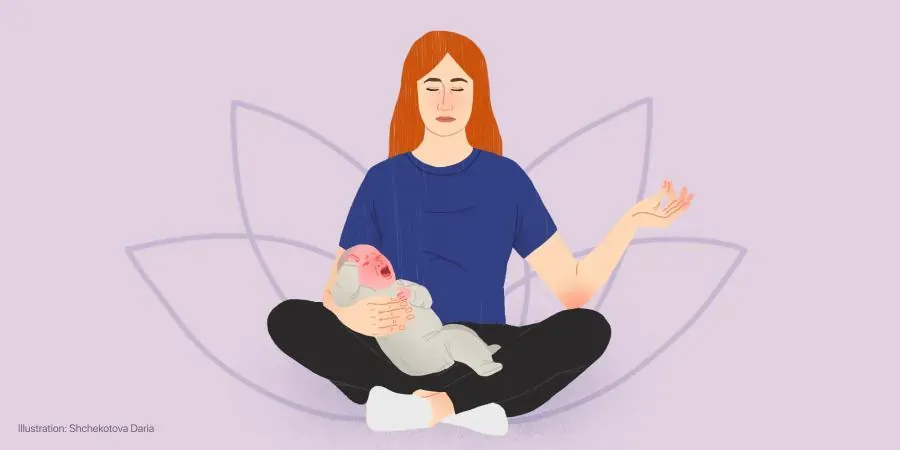

Even if you get a miracle baby who sleeps through the night (at least, at first), parenting a newborn is very stressful. Expect lots of crying — because of hunger, because of a dirty diaper, because of a belly ache, because of teething… So this is the perfect time to develop a plan for when that stress hits.
The following are some mental exercises you can learn and practice ahead of those stressful moments. They will help dissolve your irritation, relieve tension, and cope with the physical and emotional stress of nursing.
Safe haven [1]
Lie down or sit comfortably. Close your eyes. Take a few leisurely, deep breaths, in and out. Imagine the air filling your lungs. Direct it down towards your belly, then exhale. With each exhalation, feel your body relax.
Now, imagine a place where you would like to be. Create an imagined place unlike any real place you know. In this place, you are calm, comfortable, and safe. No one and nothing can disturb you here.
Picture this place in detail; look at the floor (or ground), the ceiling (or sky) overhead, the walls, the furniture, items and decoration… Walk around and touch things. Feel the air, the temperature. Feel how pleasant and beautiful it is.
Now, fill the space with sounds. What soothing sounds belong here? What are your favorite sounds: bird song, a crackling fireplace, wind chimes? Pause to enjoy the sounds you have brought into your space.
Move on to smells: what does it smell like here? Choose a smell that makes you happy or calm. Enjoy the scent and let it fill the air around you.
Stay in your safe haven for as long as you want. Then take a few breaths, stretch, and open your eyes.
After this mental journey, you should feel calm and restored. You can practice this exercise before bed, as it’s a great way to relax for sleep.
Three-minute meditation [1]
This is a short exercise, which is a huge plus in moments of stress! When you’re overwhelmed, angry, or fatigued, try this meditation with a timer to melt away the negativity and regain peace. Practice it now so you’re great at it when the stress really hits.
While it’s better to do this exercise sitting, you can also stand. Your eyes can be open or closed.
To begin: Sit
Feel the full weight of your body comfortably settling into your chair. (If you are standing, feel the floor solidly under your feet.) Align your spine, neck, and head so you are up straight.
Minute 1: What is
Be attentive to what is. What thoughts are you having? What feelings? What bodily sensations do you have? Allow all of these thoughts, feelings, and sensations to make themselves known. Don’t try to block or change them; just observe and acknowledge them.
Minute 2: Breathing
Switch your focus to your breathing. Feel the expansion of your inhalations and the contraction of your exhalations. For this minute, give your mind only one thing to do: breathe. Breathe deeply, letting each breath nourish you.
Minute 3: Body
Move your attention from your breaths to your body. Move out from your lungs to your back, neck, and head; to your shoulders, arms, wrists, hands, fingers; and to your abdomen, hips, legs, ankles, feet, and toes. Pay attention to the sensations of your skin, the air touching your skin, and then move your imagination through that air into the rest of the room.