
EN
try amma today
Your baby is well protected
Pregnancy

Your baby is well protected

2 min readWeek 6
Key takeaways
2 min
  • Understand that your embryo develops rapidly from a C-shaped tadpole into a recognizable form with basic organ systems forming by week's end.
  • Monitor early development milestones including heart formation, brain hemispheres, and the beginning of circulatory and nervous systems.
  • Recognize that the amniotic membrane provides crucial protection throughout pregnancy while the yolk sac supplies essential nutrients.
  • Observe ultrasound features showing the tiny embryo, developing brain as white dots, and early limb buds as small dashes.
  • Plan ahead for your growing baby by considering baby names while understanding these critical early developmental stages.

During early pregnancy, your baby is well protected by the amniotic membrane that forms around the C-shaped embryo. The heart begins beating, brain hemispheres develop, and basic organ systems form while the protective amniotic sac provides a safe environment for growth.

amma app

Track your pregnancy in the app

Personalized content for your pregnancy week

Download App

Your baby is well protected

At this time, the embryo looks like a C-shaped tadpole and the amniotic membrane has formed and will protect your growing baby throughout the pregnancy.

Your baby is well protected - Your baby is well protected

Even though the baby is tiny, the first blood vessels are already forming to create the circulatory system. Heart tubes develop to form a two-chamber heart, with one ventricle and one atrium. By the end of the week, the baby’s heart will begin to beat [1].

The central nervous system also begins to develop: segments of the brain and spinal cord form from the central neural tube and the brain forms cerebral vesicles that will grow into the left and right hemispheres.

The endocrine system is also developing, beginning to form the thyroid, parathyroid, and anterior pituitary glands. The basic structures of the respiratory and digestive systems begin to develop this week, with the trachea, lungs, liver, and pancreas.

Dimples start to form where the baby’s ears will develop.

What we can see on an ultrasound

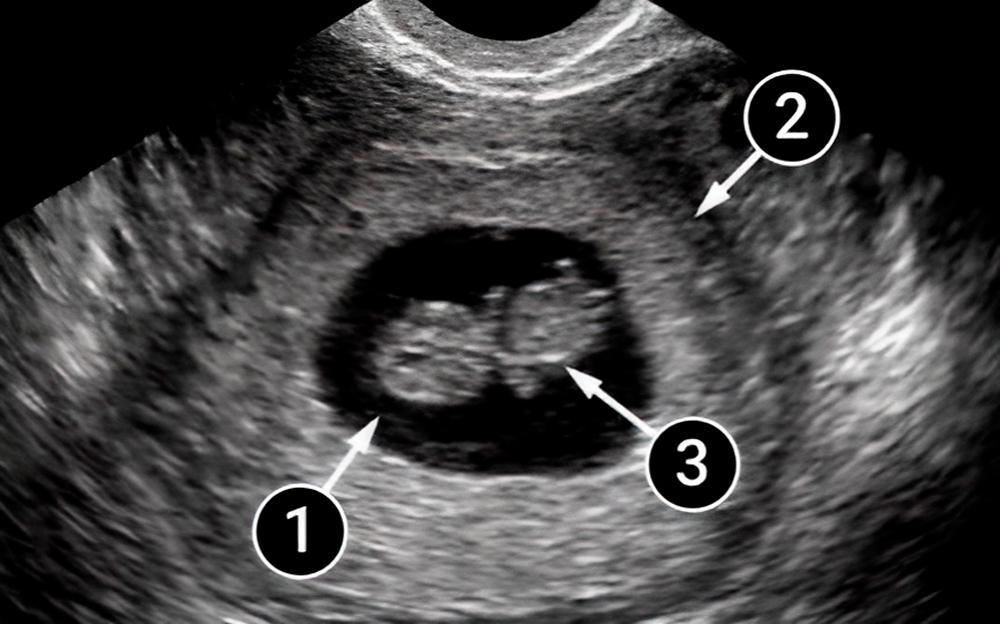
In this photo, the contour of the growing uterus is outlined. The baby appears as a tiny tadpole floating in the amniotic fluid. The brain appears as two white dots — which will grow into the right and left hemispheres. The little white dashes at the top and bottom are the beginnings of the baby's arms and legs.

The small dark spot is the baby’s developing heart.
Your baby is well protected - Your baby is well protected
Frequently asked questions

A baby's heart begins to beat by the end of the first few weeks of embryonic development. The heart initially forms as tubes that develop into a two-chamber structure with one ventricle and one atrium.

The amniotic membrane forms early in pregnancy and protects the growing baby throughout the entire pregnancy. This protective sac surrounds the embryo with amniotic fluid, creating a safe environment for development.

On early ultrasounds, you can see the embryo as a tiny tadpole-like shape floating in amniotic fluid. The brain appears as two white dots, limb buds show as small dashes, and the developing heart appears as a small dark spot.

You can start considering baby names as soon as you discover you're pregnant. Many parents begin exploring baby names during early pregnancy while learning about their baby's development and growth milestones.

The heart, brain, and spinal cord are among the first organs to develop in early pregnancy. The central nervous system, circulatory system, and basic structures of respiratory and digestive systems all begin forming within the first few weeks.

Medical Disclaimer

This article is for informational purposes only and is not a substitute for professional medical advice, diagnosis, or treatment. Always seek the advice of your physician or qualified health provider with any questions you may have regarding a medical condition.

Meet our medical experts

Medically reviewed content

Reviewed by healthcare professionals · Updated June 5, 2025

This article is based on peer-reviewed research and trusted medical sources.

  1. Fetal Development. Mark A Curran, M.D., F.A.C.O.G.

Track your pregnancy on the go

Rated 4.8417,594 reviews