
EN
try amma today
You can hear the baby's heartbeat yourself
Pregnancy

You can hear the baby's heartbeat yourself

3 min readWeek 29
Key takeaways
3 min
  • Listen for your baby's heartbeat by placing your ear on your partner's belly in a quiet setting, though it may take several attempts to hear it clearly.
  • Monitor fetal heart rate which ranges from 120-160 beats per minute during this stage, significantly higher than adult heart rates.
  • Recognize that babies develop reflex reactions and can respond to loud sounds by folding their arms and shifting their legs.
  • Understand that twins' hearts don't always beat in unison and they react to each other's movements with increased heart rates.
  • Prepare for tooth development as babies already have tooth foundations covered with enamel that will erupt 6-9 months after birth.

You can hear your baby's heartbeat by placing your ear directly on your partner's belly in a quiet setting. The fetal heart rate ranges from 120-160 beats per minute, much higher than adults due to the small heart size working harder to pump blood.

amma app

Track your pregnancy in the app

Personalized content for your pregnancy week

Download App

You can hear the baby's heartbeat yourself

The baby is becoming very active, but increasingly cramped. The uterus restricts their movements, but they can still jerk their legs as if riding a bicycle. Later, this skill will help the baby roll their head upside down to get into position for childbirth.

The baby is also developing reflex reactions. Hearing a sharp, loud sound or feeling unusual movements can cause them to fold their arms over their chest and shift their legs [1].

By this time, the baby has fully formed eyelashes. The central nervous system now regulates body temperature and rhythmic breathing movements [2], while subcutaneous fat continues to accumulate [3].

The baby's heart rate is around 120 to 160 beats per minute; lower than at an earlier stage but still much higher than an adult’s. The heart is still very small, so it needs to work hard to pump blood through the vessels.

Your doctor can listen to the baby’s heart rate with a stethoscope. You can hear it by just placing your ear to your partner’s belly. It may not work the first time, but you should be able to hear it in a quiet setting [4].

The baby already has the foundation for teeth, which are covered with enamel. About six to nine months after birth, they will erupt through the gums [5]. When that happens, it’s normal for your baby’s sleep patterns to change or regress because of the discomfort caused by teething.

If your partner is expecting twins

Twins’ hearts do not always beat in unison. Doctors note that twins react to each other, like when one makes a sudden movement, the second one gets startled and their heart beats faster [6].

What we can see on an ultrasound

The picture shows the baby’s right hand. The elbow joint, forearm, and hand are also visible, with clearly marked finger bones.
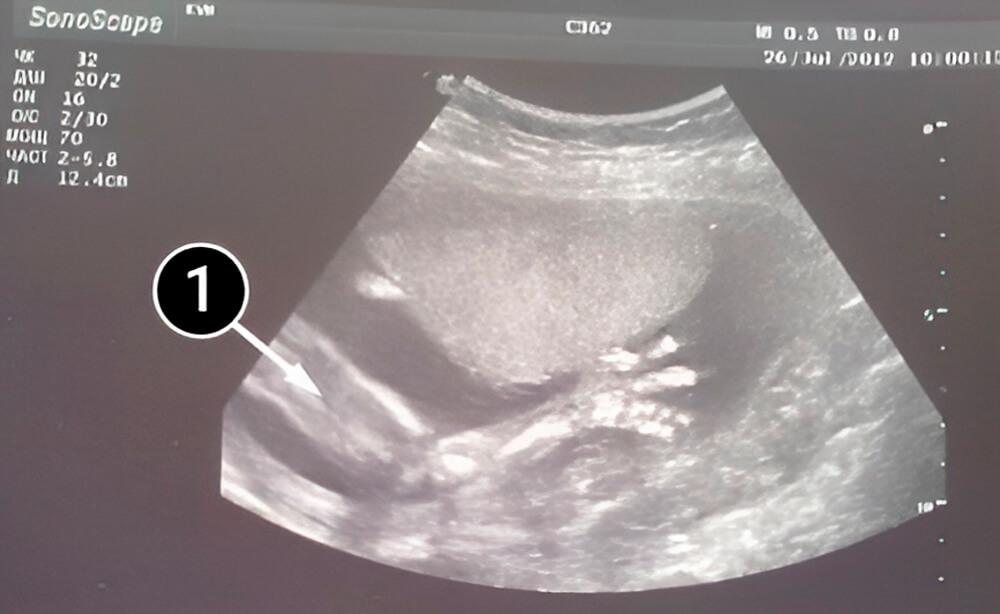

You can hear the baby's heartbeat yourself - You can hear the baby's heartbeat yourself
Frequently asked questions

You can typically hear a baby's heartbeat with a stethoscope or by placing your ear on the belly during the second trimester. The heart rate ranges from 120-160 beats per minute at this stage.

A normal fetal heart rate is between 120-160 beats per minute. This is much higher than an adult's heart rate because the baby's heart is small and works harder to pump blood.

Yes, you can hear the baby's heartbeat by placing your ear directly on your partner's belly in a quiet setting. It may not work on the first attempt, but with patience you should be able to detect it.

No, twins' hearts do not always beat in unison. Twins react to each other's movements, and when one makes a sudden movement, the other may get startled and their heart rate increases.

Babies become very active but increasingly cramped as the uterus restricts movement. They can jerk their legs like riding a bicycle and develop reflex reactions to sounds and unusual movements.

Medical Disclaimer

This article is for informational purposes only and is not a substitute for professional medical advice, diagnosis, or treatment. Always seek the advice of your physician or qualified health provider with any questions you may have regarding a medical condition.

Meet our medical experts

Medically reviewed content

Reviewed by healthcare professionals · Updated September 8, 2024

Track your pregnancy on the go

Rated 4.8417,594 reviews