

One of you believes in a strict upbringing for your baby, and the other might be inclined to a more relaxed and free atmosphere [1]. The two are not necessarily mutually exclusive. The main thing to focus on is consistency.
A child’s psychological stability can benefit from their parents reacting similarly to a certain behavior [2]. When limits are blurry and rules are not followed, a child can feel vulnerable, nervous, and anxious. The good news is that even parents with very different views can achieve consistency in parenting. Here are a few tips.
Find your points of contact
This exercise can help you visualize your approach to parenting. Draw an XY graph where X represents control and freedom (one on each end), and Y represents proximity and distance (again, one on each end) [3].
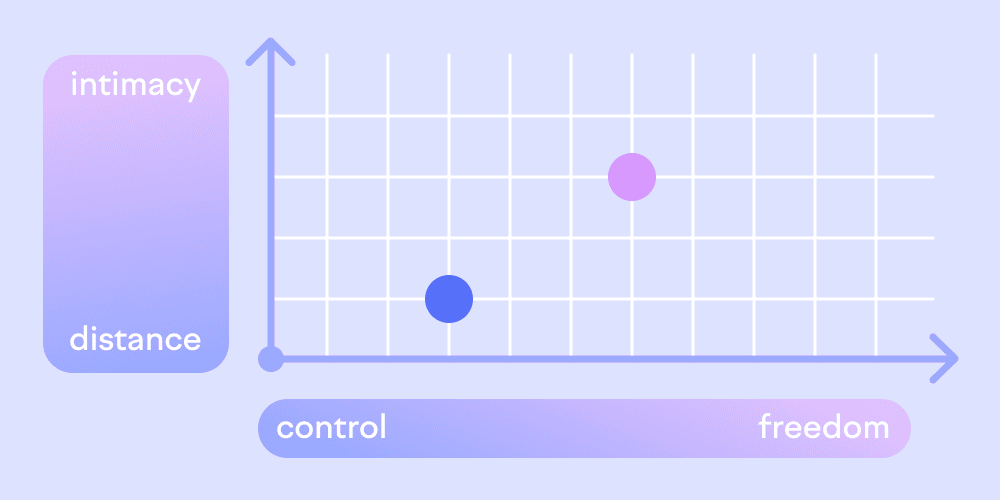
Reflect on which of the poles of each axe you gravitate towards. Do you believe parents should clearly tell their children what is acceptable and what is not? Then you are closer to the "Control" side. If you are convinced that children should have more freedom of choice, then you lean more towards the “Freedom” mark.
Give it a try. It’s less complicated than it sounds. For example, if you are prone to tenderness and affection, move towards the “Proximity” mark; if you believe a parent should be strict and display authority, place yourself closer to the “Distance” point in the graph. If you are against extremes, then position yourself in the middle. Play around with the exercise to find out more about your parenting style.
After a while, you will have your coordinates and can ask your partner to do the exercise as well. The idea is to graphically assess how close or far apart your parenting styles are.
The exercise is a great conversation starter. It can help you find common ground and prioritize what’s important to both of you. You can agree that being kind and affectionate to your child is a priority, but disagree on how strict the rules should be. A good parenting team always tries to find points of convergence and negotiate differences without missing the ultimate goal, which is to raise a happy and healthy child.
Bring your positions closer together
But what about those points where your approaches differ? Listen to each other and find things that you both agree on.
For example, a strict parent may not believe that a child needs to be comforted whenever they cry but accepts that shouting at them is unacceptable. One parent may think that a child should not be overly restricted but agree that boundaries are needed, like not allowing them to eat too much candy or hit another child, even when playing.
Use the trial and error method
If you still find it difficult to agree, test out your parenting styles in real life. For a time, approach situations the way your partner wants to, and then do things your way. Be objective and decide which approach works better based on the results of the experiment [4].
Avoid disagreeing in front of your child
Babies start understanding words when they are about one year old, but they can sense tension between their parents sooner. Smooth out any disagreements after you put the baby to bed and avoid contradicting each other in front of them [4].
Accept your differences
No matter how much you try to build a united front, your parenting styles can still be slightly different, and that is a good thing! Your child will learn to adapt to both mom and dad, which will help them learn to communicate with different people and prepare them for when they go to school and start interacting with the outside world [4].