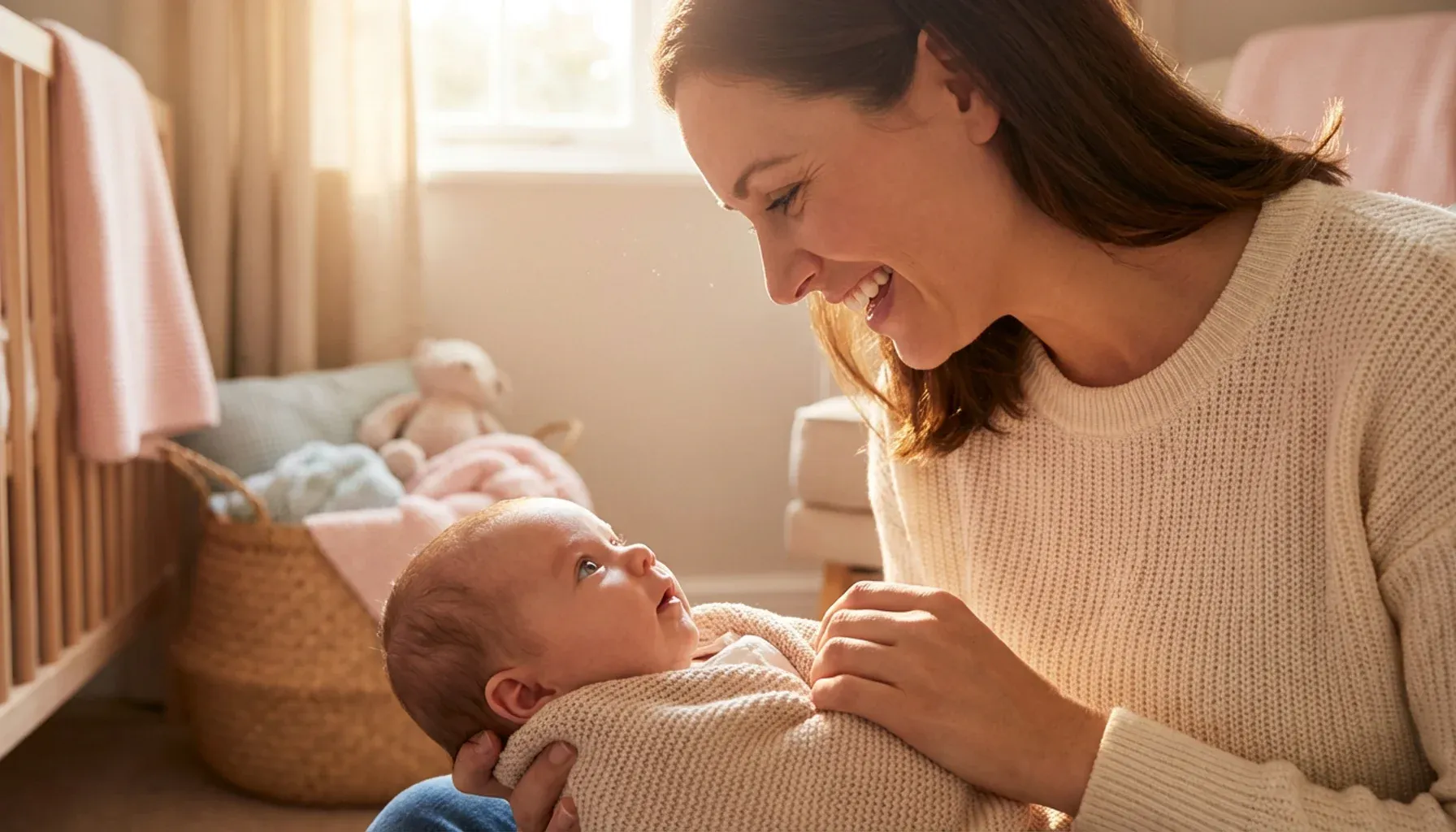

A strong bond is established between mother and child even during pregnancy. And after birth, the baby interacts with the world only with an eye on the mother.
When a baby lives in your belly, the world for him is limited by the space of the uterus. It is warm and comfortable, there is food, and mom's heartbeat determines the rhythm of life.
What happens when a baby is born? It would seem that he should feel horror at the fact that everything around him has become different. But in fact, he behaves as if many things are already familiar to him. He presses against his mother's chest, recognizes her voice.
Is it because he meets his mother already in the stomach?
In a way, yes. Studies show that a baby, even in the womb, knows how the mother's voice sounds — his hearing is already able to distinguish him from others [1, 2]. In addition, he already knows the smell of his mother — he feels it, swallowing amniotic fluid [3].
Therefore, after birth, the baby already knows something about his new world. When his mother sings him a lullaby, he calms down. The newborn reaches for the breast because it has a familiar scent — the one that he associates with calmness and comfort [3].
In the 1940s, psychiatrist Rene Spitz proposed to designate the union of mother and baby with the concept of "dyad". In his opinion, they represent a single community: a child does not exist apart from his mother. In addition, the scientist argued that the baby does not perceive the outside world as something separate. Everything around is a continuation of himself [4].
And where is mom in his world?
Mom is also part of his world. And there is no contradiction in this. A child looks at the world differently from an adult. He does not break it into parts: for him, the concepts of "me", "mother" and "world" are one and the same. The mother's breast is a part of his body, the voice of his mother is the way the world speaks to him [4].
Therefore, according to Spitz, at the beginning of life, the baby cannot interact with the environment in any other way, except through the mother. She is his guide to this world. However, a mother can be replaced by another close one, for example, her partner — science says that children are good at forming affection with dads [5].
Modern psychologists believe that a child lives with such a picture of the world for up to three years — then gradually his own self, important people and the rest of the environment are isolated from the whole world.
When is the community of mother and baby formed?
In the broadest sense of the word — even before conception. Because already at this time, the woman has an image of the unborn child, she begins to think of herself as a mother, to realize her maternal role. These beliefs affect the relationship with the baby after birth.
What is the main role of the mother?
Protect and take care of the child. He is born small and helpless, so he expects to receive support and protection from his mother. Of course, a newborn does not think about it the way an adult does, but evolution has taught its brain to count on being helped to survive. One baby cannot cope, so he reaches out to his mother, attracts her attention [6].
A mother (or another close person) should notice what is happening to the baby, feel when he is not feeling well, react to his signals: feed, soothe, lull, be near when he needs it [6].