EN
try amma today
Do babies get hiccups?
Pregnancy

Do babies get hiccups?

2 min readWeek 31
Key takeaways
2 min
  • Recognize baby hiccups as light, rhythmic twitching sensations in your belly that feel different from kicks or larger movements.
  • Understand that fetal hiccups are normal diaphragm contractions that may help with lung development, though the exact cause remains unknown.
  • Distinguish hiccups from kicks by noting the pattern - hiccups are small and rhythmic while kicks are larger, more random movements.
  • Expect to feel hiccups more clearly after 28 weeks of pregnancy when baby movements become more pronounced.
  • Know that increased fetal movement or hiccups after meals is normal and experienced by about 12% of mothers.

Yes, babies do get hiccups in the womb. These hiccups are diaphragm contractions that create rhythmic twitching sensations in your belly. While the exact cause is unknown, fetal hiccups are completely normal and may help with lung development during pregnancy.

amma app

Track your pregnancy in the app

Personalized content for your pregnancy week

Download App

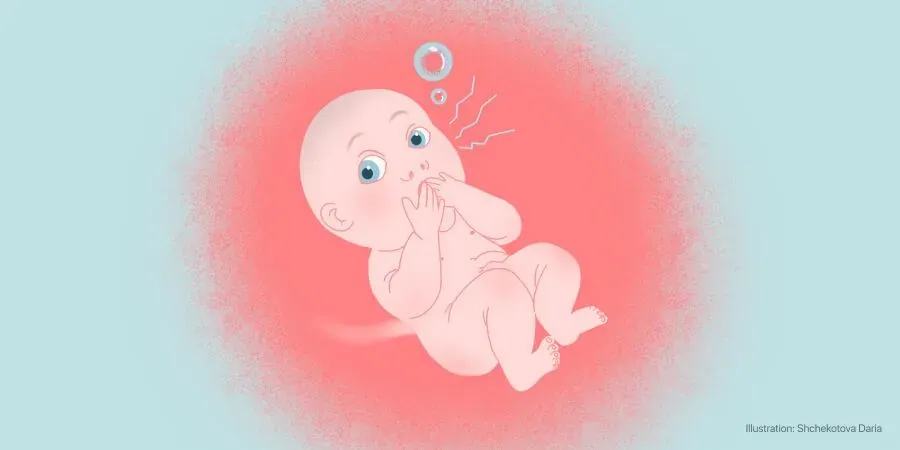
If you feel a light rhythmic twitching in your belly, it’s likely your baby is hiccupping. Although hiccups can be easily confused with some other small baby movements, babies do get hiccups while in utero.

Why does the baby hiccup while in the uterus?

Science has not yet figured this out. We don’t even know why adults hiccup. Hiccups are contractions of the diaphragm. Tt may be possible that hiccups in utero are linked with the development of the lungs.

Intrauterine hiccups were first described by the German gynecologist Mermann in 1887. Throughout the twentieth century, doctors and researchers have addressed this topic, calculated the number of twitches per minute, correlated them with the heart rate and the state of the baby after childbirth. But why some babies hiccup and how it affects their development is still unclear [1].

Hiccups are such small movements. Why do I feel it?

A sudden contraction of the diaphragm (this is hiccups) leads to a sharp displacement of the chest and abdomen of the fetus. Reacting to his unexpected movement in the space of the uterus, the child reflexively moves his arms and legs — it is difficult not to feel the whole set of movements [1].

How do I know if it’s a hiccup or kick?

It’s subjective: what mom considers a hiccup is a hiccup. In Australia, a large-scale study was carried out on this topic [2]. Women over 28 weeks of gestation were asked not to count, but to describe the baby's movements. If we discard all the lyrics and poetic images, it turns out that babies perform two basic movements: "pushing" and "hiccuping". That is, expectant mothers are usually distinguished by large movements of the body or limbs and small rhythmic ones. And whether the baby wiggles his palm or hiccups is actually not very important.

About 12 percent of mothers noted that movements become more frequent during or after meals [2]. Since hiccups in adults are often associated with overeating [3], we tend to transfer our ideas about cause and effect to the baby as well.



Frequently asked questions

Yes, babies do hiccup while in the uterus. These hiccups are contractions of the diaphragm that create rhythmic twitching sensations you can feel in your belly.

Hiccups feel like light, rhythmic twitching in the same spot, while kicks are larger, more random movements. Hiccups typically last longer and have a consistent pattern.

Babies can hiccup throughout pregnancy, but most mothers start feeling them clearly after 28 weeks of gestation. The movements become more noticeable as the baby grows larger.

Yes, fetal hiccups are completely normal and may even help with lung development. They're a sign of healthy nervous system development and diaphragm function.

About 12% of mothers notice increased fetal movement or hiccups after meals. This may be related to changes in blood sugar levels or the baby's response to increased activity in your digestive system.

Medical Disclaimer

This article is for informational purposes only and is not a substitute for professional medical advice, diagnosis, or treatment. Always seek the advice of your physician or qualified health provider with any questions you may have regarding a medical condition.

Meet our medical experts

Medically reviewed content

Reviewed by healthcare professionals · Updated June 7, 2025

Track your pregnancy on the go

Rated 4.8417,594 reviews