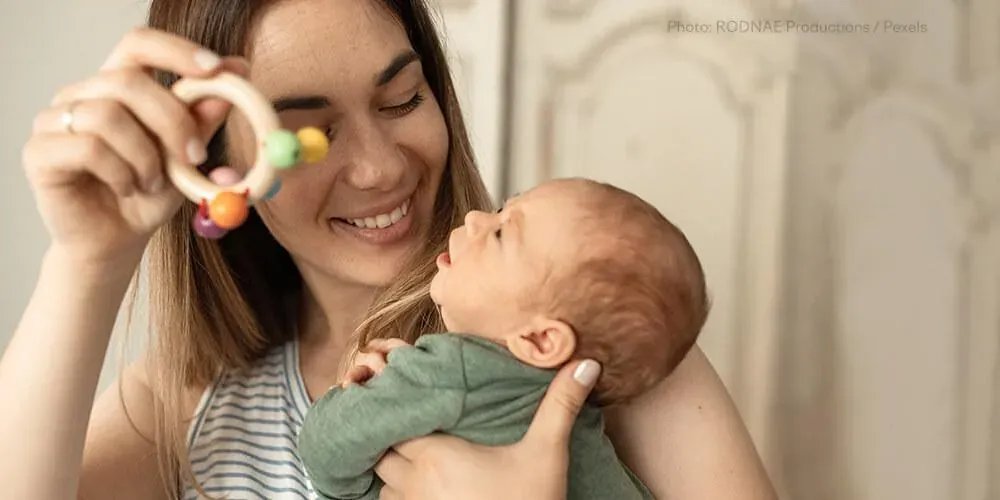

Baby is waving his arms and smiling sweetly, but a full conversation with them is not yet possible. But this does not mean that mom and dad shouldn’t talk to baby all the time.
Why say anything? The baby does not understand anything.
Actually, babies understand more than you’d expect. Speech perception is a very complex process with many layers. Yes, the baby doesn't understand the words we say. But they understand the intonation perfectly [1]. They knew this even before they were born! The pitch and modulation of the voice, as well as the pace of speech, both excite and calm the baby.
Adults perceive language similarly. Think about it. The tone and volume of someone's voice help us determine whether they are upset, happy, angry [2], or telling a lie [3]. Imagine you're listening to a song in a foreign language. You will certainly be able to understand without words whether it’s about a happy meeting or a sad departure.
Can I talk to a baby in gibberish?
Yes, they are currently focused solely on intonation. Words are secondary. However, it is preferable to use natural language. The more you communicate with your baby, the more likely they will learn to speak when the time comes.
A study conducted by scientists from Stanford University and New York University found that children with parents who communicate with them frequently learn new words faster and have a larger vocabulary by the age of 1.5-2 than toddlers with less communicative parents [4]. Even passive listening has been shown to activate the Broca's zone in children, which is the brain's speech center [5]. So it's better to talk with the baby in a real language.
So should I talk to a baby like an adult?
Yes, speaking as usual is fine. It is not necessary to deliberately distort words and simplify sentences. Speak slowly, in a high voice, and stretch the vowels. Psychologists believe that this type of speech is most beneficial to babies [6].
And what should I talk about with the child?
Be guided by the principle "what I see, I say." That is, comment on everything you do for the baby. Talk about everything you see around you. Imagine that you are speaking on the radio and want to describe in detail everything that is happening for your listeners.
It may be difficult for you to get used to this manner of communication. But try to make it a habit. It is critical to the child's overall development.
Photo: RODNAE Productions / Pexels