
Baby’s unique features are more distinguishable
At this point, the baby’s face rounds out more and tufts of hair appear on top of their head [1]. Their body is now covered with downy hair called lanugo [1], which helps protect their delicate skin from the amniotic fluid by holding natural skin lubrication. It also retains body heat.
As the cerebral cortex continues to develop, new reflexes appear. The baby’s movements become more complex as they touch their arms, legs, and the front of the body.
The pancreas begins to produce insulin, and the spleen produces lymphocytes. The liver, which has functioned as a circulatory system organ, now shifts to a digestive function. The stomach, intestines, and gallbladder kick into gear.
In boys, the prostate forms, and in girls, the ovaries begin to descend from the abdominal cavity into the pelvic cavity. External genitalia develops for both boys and girls, but they are still not always visible on an ultrasound.
The amniotic fluid is circulated and refreshed 8-10 times a day [2]. This maintains a naturally sterile environment and a healthy chemical composition for the baby’s growth.
If your partner is expecting twins
At this time, if not for the ultrasound, you might not have guessed that your partner is carrying twins. The babies have enough space, and they develop in the same way as all babies do [3].
Each of them is now the size of a small lemon, and they do not interfere with each other at all.
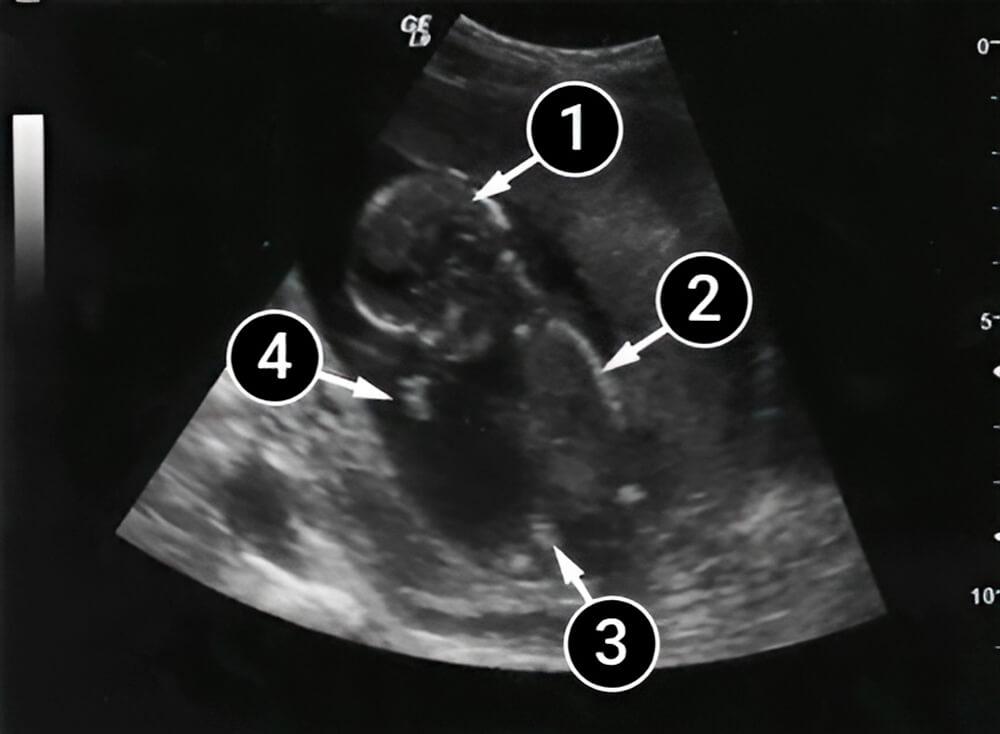
What we can see on an ultrasound
The baby’s legs will be bent due to their rapidly forming skeletal and muscular systems. They now want to move around and can already touch and stroke their body!
The toes, heels, and spine are all visible on an ultrasound. The baby's arms are bent and their left elbow and hand, including the palm, are visible. You can also see the bones in their skull, neck, and shoulders.