
Your underwear tells a story — and decoding that story can feel like trying to read ancient hieroglyphics. One day you're noticing stretchy, clear discharge that reminds you of egg whites, and the next week it's thick and milky. Many moms tell us they've stared at toilet paper wondering: "Is this ovulation or could I be pregnant?"
The truth is, your cervical discharge changes dramatically throughout your cycle, and recognizing these patterns can be incredibly helpful whether you're trying to conceive or just want to understand your body better. Let's break down the key differences between what you'll see during ovulation versus early pregnancy.
What Your Discharge Looks Like During Ovulation
When you're ovulating — typically around day 14 of a 28-day cycle — your body produces what fertility experts call "fertile cervical mucus." This isn't just medical jargon; it's actually pretty descriptive of what you'll see.
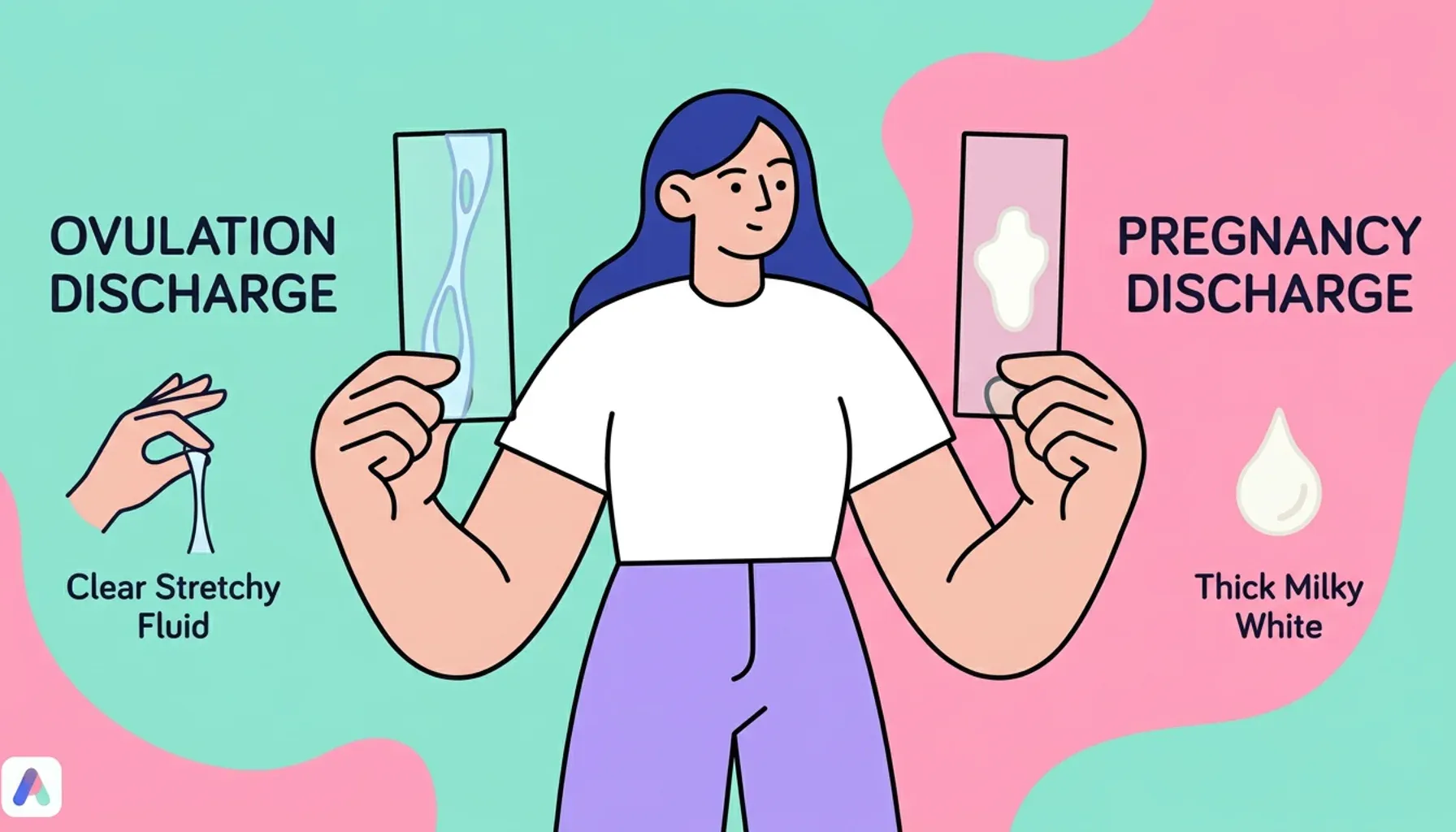
Ovulation discharge has a very distinctive appearance that many women describe as looking exactly like raw egg whites. You can literally stretch it between your fingers for several inches without it breaking. The American College of Obstetricians and Gynecologists notes that this stretchy quality, called "spinnbarkeit," occurs because estrogen levels peak right before ovulation, changing the molecular structure of your cervical mucus.
The color during ovulation is typically clear or slightly cloudy — think of how egg whites look when they're fresh. You might notice an increase in the amount too. While some women produce just enough to notice on toilet paper, others find they need to wear a pantiliner for a day or two.
Here's something you might not expect: ovulation discharge often has a very mild, sweet smell. It's not unpleasant at all — quite different from the fishy or strong odors that signal infections.
Early Pregnancy Discharge: What Changes
If conception occurs, your discharge story takes a completely different turn. Early pregnancy discharge — what doctors call "leukorrhea" — looks and feels quite different from that stretchy ovulation mucus you might have noticed a week or two earlier.
The most obvious difference is texture. Instead of that clear, stretchy consistency, pregnancy discharge becomes much thicker and creamier. Many women describe it as looking like lotion or whole milk — it's got that same opacity and consistency. This change happens because progesterone levels stay elevated after conception, rather than dropping like they would before your period.
Color-wise, early pregnancy discharge is typically white or off-white, though it can sometimes have a very slight yellowish tinge. What you won't see is the crystal-clear appearance of ovulation discharge. Research published in the Journal of Obstetrics and Gynaecology shows that this increase in vaginal discharge affects up to 65% of pregnant women, starting as early as one to two weeks after conception.
The amount often increases too, but gradually. You might not notice it immediately — it's not like a faucet suddenly turns on. Instead, you'll probably realize over several days that you're seeing more discharge than usual.
Timing: When You'll Notice Each Type
Timing is actually your biggest clue for telling these two types of discharge apart. Ovulation discharge follows a pretty predictable pattern if you track it over a few months.
For most women with regular cycles, that telltale egg-white discharge appears about 12-48 hours before ovulation actually occurs. So if you have a 28-day cycle, you'll typically see it around days 12-14. The World Health Organization's research on fertility signs shows this timing holds true for about 70% of women with regular menstrual cycles.
Pregnancy discharge, on the other hand, doesn't follow your usual cycle pattern at all. Instead of appearing mid-cycle, it often becomes noticeable around the time you'd expect your period — or even a few days before. This timing overlap is why many women initially think their period is just starting differently.
But here's where it gets interesting: if you're pregnant, that thick, milky discharge doesn't disappear after a day or two like ovulation discharge does. Instead, it tends to stick around and often increases as pregnancy progresses.
Other Signs That Might Accompany Each Type
Your discharge rarely travels alone — it usually brings friends in the form of other symptoms that can help you figure out what's happening.
During ovulation, you might notice a slight increase in your basal body temperature (about 0.4-0.8°F), some mild pelvic pain on one side (called mittelschmerz), or even a brief increase in sex drive. Some women tell us they feel more energetic and social during their fertile window — nature's way of encouraging reproduction, perhaps.
Early pregnancy discharge often comes with a different set of companions. You might notice your breasts feeling more tender than usual, some mild cramping that feels different from period cramps, or that famous early pregnancy fatigue. According to the American Pregnancy Association, about 25% of women also experience very light spotting around the time of implantation, which typically occurs 6-12 days after ovulation.
When to Check In With Your Healthcare Provider
While both ovulation and pregnancy discharge are completely normal, there are some red flags worth knowing about. Any discharge that comes with itching, burning, a strong fishy smell, or unusual colors like bright yellow or green deserves a conversation with your doctor.
If you're trying to conceive and tracking your discharge patterns, sudden changes that don't fit your usual cycle might be worth mentioning at your next appointment. And of course, if you suspect you might be pregnant, a simple home pregnancy test (taken after a missed period for best accuracy) will give you much more reliable information than discharge analysis alone.
The bottom line? Your body is constantly communicating with you through these changes. Learning to recognize the difference between ovulation and pregnancy discharge is just one more way to tune in to what's happening inside. Whether you're hoping to get pregnant, trying to avoid pregnancy, or simply want to understand your body better, paying attention to these patterns can provide valuable insights into your reproductive health.