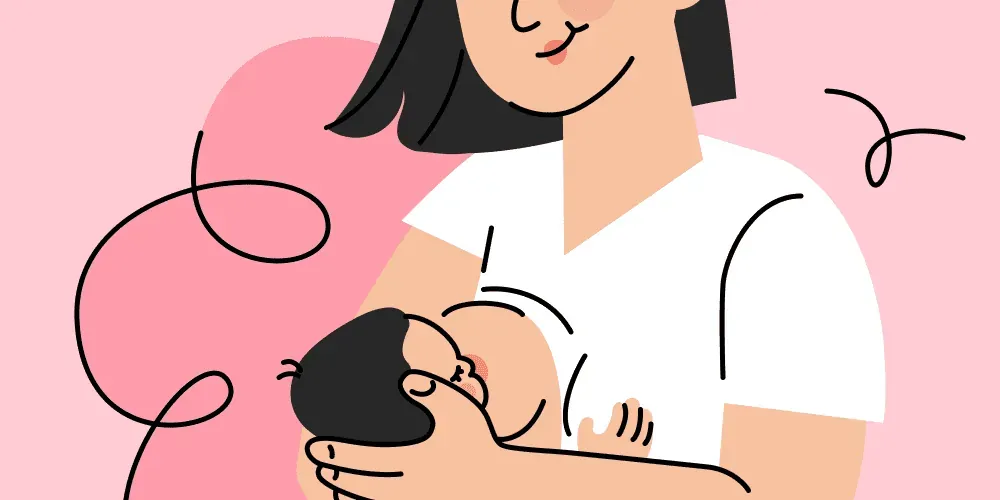

If you’ve never seen a new mother breastfeeding for the first time, you may think that breastfeeding is straightforward: there’s breast, there’s baby, and voilà! But one hundred percent of experienced mothers know it’s more complicated than that.
Most mothers face some kind of challenge when they start breastfeeding and it’s completely normal to have difficulties when learning this brand new skill [1]. Often, good nipple care is what’s needed. Here’s what you need to know.
Do I need to disinfect my nipples before feeding?
Most definitely not! The smell of mama and colostrum is familiar to baby from the moment of birth. To wash it off would discourage baby from breastfeeding [1]. In addition, frequent washing will dry out your nipples and increases the likelihood of cracking [2].
What do I do if my nipples become inflamed and sore?
The best medicine for both mother and baby is breast milk. After the shower, squeeze out a drop of milk and smear it on the nipple and areola. It is an excellent emollient and wound healing agent [2].
It’s rare that an infection on sore nipples will require medicine. But if there’s blood or pus, your doctor can analyze the discharge. This may be a bacterial infection (most often streptococcal or staphylococcal) or a fungal infection such as thrush (candidiasis) [3].
If it's an infection, can I continue feeding?
Usually, yes. If the infection is bacterial, the mother may be prescribed oral antibiotics. In this case, the doctor will decide depending on the class of antibiotics and the condition of baby. You may need to pump for several days to maintain lactation [2].
And if it is a Candida fungus (thrush), then the doctor will prescribe antifungal creams or ointments, which should be applied to the nipple after feeding. Before the next feeding, the ointments do not need to be washed off. Most likely, the same drug will be prescribed to the child to smear the gums affected by thrush. Depending on how much the infection has spread, it will go away after one to three weeks [3].
If there is no infection, what ointments will help?
There is no evidence that any wound healing agents actually work. Stick to using breast milk for sore nipples [2]. However, gel nursing pads applied directly to the breast are easy to use and help soothe sore nipples.
Why do my nipples hurt and crack?
In 90% of cases, pain and cracks have at least two or three causes [3]. The most common is baby is in the wrong position when feeding: if baby doesn’t have a good latch, it will cause the nipple to crack or become sore [2, 3]. Talk to a lactation consultant to help you achieve a good latch with your baby if you are experiencing pain while nursing. She will coach you and give you advice for how to position baby and your breast for the best latch.
Experiencing any pain while nursing is a reason to consult a pediatrician or lactation consultant. Baby may have:
a short frenulum of the tongue (causing a poor latch);
spasms of the blood vessels of the brain (causing biting of the nipples) [3].
You may have a blockage of the milk duct or a lack of milk. In this case, nursing frequently is the best treatment. But if it is very painful, you can express yourself between feedings [2, 3]. Whatever the cause of your pain, a lactation consultant will be able to give you advice. While breastfeeding should not be painful, it is completely normal to experience challenges during breastfeeding, especially for first time mothers.