Your baby could now survive outside the womb
As the eighth month of pregnancy comes to an end, the baby continues to develop, but all internal organs are already fully formed. They are building the subcutaneous fatty tissue that will help keep them warm after birth [1, 2]. In boys, the testicles gradually descend into the scrotum. At birth, their genitals may look enlarged because they swell due to the flow of fluid and hormonal activity, but they reduce to a normal size in a few days [2].

Your baby can distinguish voices well and can recognize their parent’s voices [1]. The cochlea, the part of the ear that transmits information about sounds to the brain, is already fully developed, so the baby can also recognize lullabies and other melodies you sing [2].
By this week, it’s getting pretty tight inside your uterus. The baby usually lies with their legs pressed to their chest. When they toss and turn to change position, you can see how the shape of your belly changes [1].
At this time, babies are considered viable and can live outside the womb if they do not suffer from any serious health issues [1]. However, babies born at this point will remain under observation in the neonatal unit for a while [3].
At this time, the volume of amniotic fluid reaches a maximum volume of about 34 fluid ounces (1 liter). Before giving birth, it will drop to about 20 ounces (600 ml) [1, 4]. The baby constantly swallows amniotic fluid, some of it will be excreted in the form of urine, and part is accumulated in the intestines in the form of meconium, the baby’s first feces. The meconium that accumulates during pregnancy will pass after the baby is born [5].
If you are expecting twins
The amount of amniotic fluid can complicate the condition of the mother. Due to the large volume of liquid, the uterus expands to the point that it becomes harder to breathe. There are also cases in which one of the twins has polyhydramnios, and the other has little water. In this instance, the mother may be offered what is called an amnio reduction, a procedure in which excess amniotic fluid is pumped out. This is a fairly safe procedure and it can prevent premature rupture of the fetal membranes and allow the pregnancy to be carried to term [6].
What can be seen on ultrasound
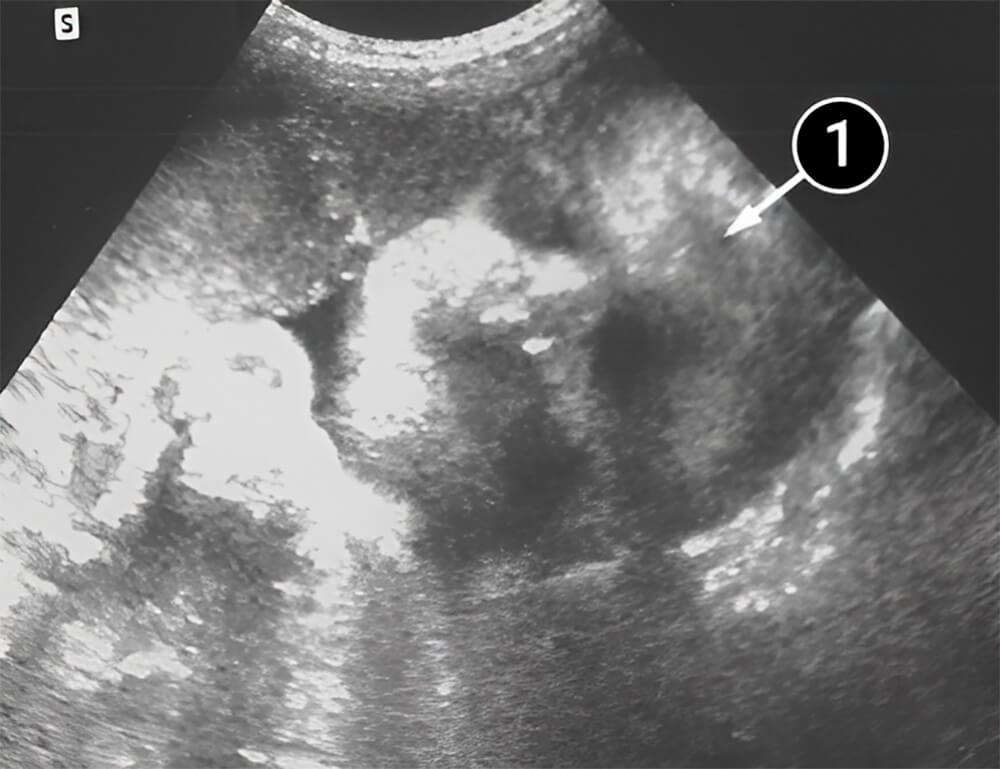
The image shows the baby’s head, as well as the contours of the eyes, nose, and chin.