
Signs of childbirth
From this week on, the baby is officially full-term. Even though a typical pregnancy is 40 weeks, only 5 percent of babies are born on their due date. So it’s a good idea to be prepared to go into labor at any moment [1].
There are a variety of physical signs that signal that your body is preparing for childbirth.
As your baby drops, it becomes easier to breathe. You may feel that the baby's head has moved to the entrance of the small pelvis, this can happen a few weeks before birth or hours before labor starts. For some women, especially those who’ve given birth before, this may go unnoticed.
You may notice that your vaginal discharge is very thick, and white or pink. This is the mucous plug, which has sealed the cervix throughout pregnancy. As the cervix softens and dilates to prepare for childbirth, the mucus plug dislodges. As you get closer to delivering your baby, this process will accelerate. Some women only lose the mucus plug with the onset of labor [2, 3].
You may experience Braxton-Hicks contractions
During the third trimester, many women will experience Braxton-Hicks contractions. This is when the stomach periodically tightens and the muscles of the uterus contract and relax. These sensations may be unpleasant, but they are not painful.
These training contractions do not lead to the onset of labor. Rather, it is a kind of preparation for the uterus. Unlike labor pains, they are irregular in their frequency, and intensity and duration do not increase over time [4].
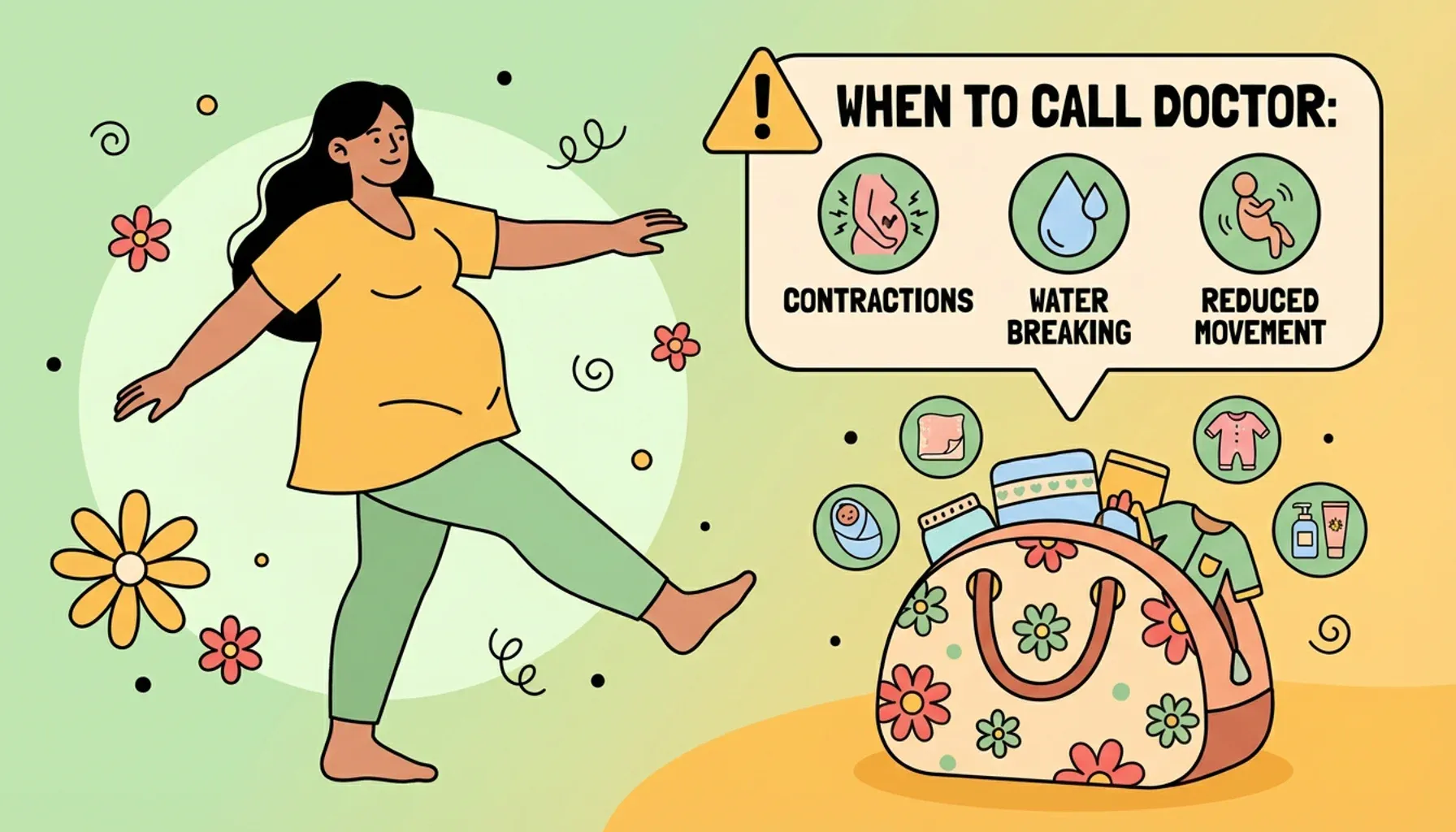
When labor contractions are strong, last more than 40 seconds, and are less than five minutes apart you should head to the hospital or call your doctor or midwife [3].
Towards the end of pregnancy, the cervix becomes softer, shorter, and thinner, gradually dilating. This process is slow at first, but as labor approaches, dilation is accelerated [2].
At some point during this stage of pregnancy, amniotic fluid may begin to leak. It can leak slowly or abundantly and rapidly. When your water breaks, you should immediately inform your doctor or midwife. Pay attention to the color of the amniotic fluid, it should be a pale yellow. If you see green, brown, or muddy-colored water you should head to the hospital immediately and inform your doctor about the color of the fluid [2, 3].
If you are expecting twins
It would seem that if there are two children, then childbirth will last twice as long. Actually, that is not the case. The first, and longest, stage of labor takes place at the same time for both babies. That is, until the full dilation of the cervix. Women expecting one, two or even three babies go through the same process.
Only the second stage takes longer, as well as the actual birth of the baby. If in single births this stage lasts one to two hours, then the birth of twins can take from one to almost four hours. With multiple births, as with normal ones, epidural or spinal anesthesia can be used. This is optimal, especially if in the process it becomes clear that a caesarean section is still necessary, as there are cases in which the first baby is delivered vaginally and the second one is delivered via caesarean [5].