
It’s time to welcome the baby
The baby will be born any day now! As your partner awaits the start of labor, she should try to find time to relax and enjoy some quiet moments before delivery. Keep in mind that the due date is only a rough estimate, and many women — especially first-time moms — give birth after [1].
The baby has completely developed and is ready to come into the world. But still, their hair is becoming thicker, nails are getting longer [2] and they continue to grow every day.
Subcutaneous fat makes the baby’s body fleshy and plump, especially around the elbows, knees, and shoulders [3, 4]. Fluffy lanugo hair is almost gone, but some traces may remain after birth [5].
Now at full term, the baby doesn’t have a lot of room to move around. So movements become smaller but should remain regular. If the mother feels that the baby is too active or too calm, she should consult her doctor [6].
After the baby is born, you will notice two spots on the top of their head where the skull is soft. These are the fontanelles, which are spaces in the skull that have not yet closed. This will help the baby pass through the narrow birth canal [2, 4].
During vaginal births, the baby’s head may become slightly conical; there may also be slight swelling or bruising. This is no reason for concern, as their head will round out a few days after birth [2].
If your partner is expecting twins
Now is the time to establish breastfeeding. It is important to alternate the babies on each breast. For example, if at first baby “A” is on the mother’s left breast, and baby “B” on the right, then on the next feeding she should start the opposite way. Since children can nurse at different intensities, the sum of the load on each breast should be even, to ensure that mom has enough milk for both babies [7].
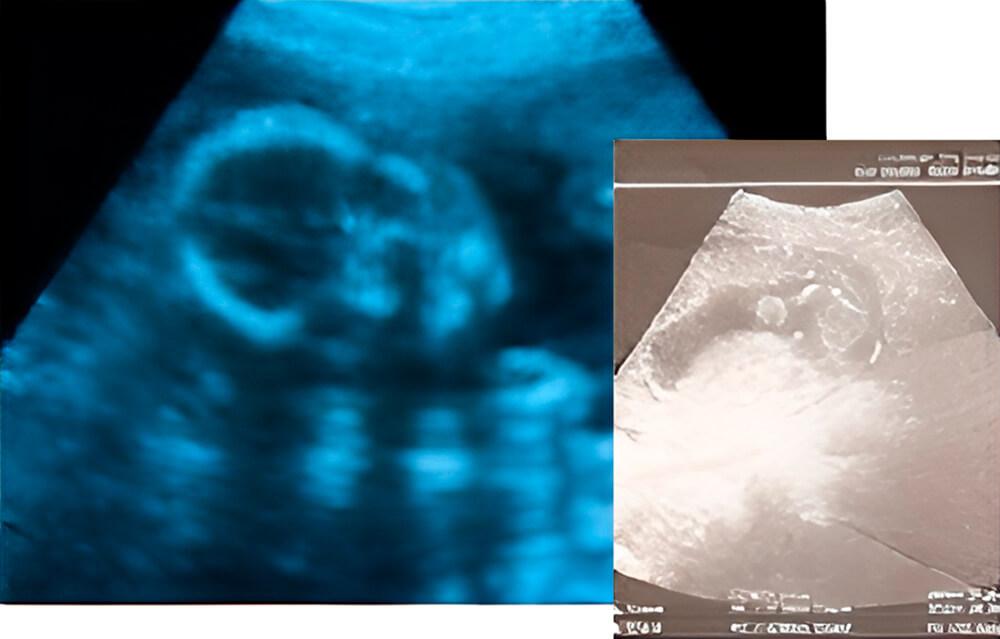
What we can see on an ultrasound
The photo shows the baby's head. The fontanelles can be seen between the bones of the skull.