EN
try amma today
It's time to think about contraception
Pregnancy

It's time to think about contraception

2 min readWeek 3
Key takeaways
2 min
  • Discuss contraceptive options with your doctor as early as two weeks postpartum, regardless of delivery method.
  • Remember that breastfeeding only protects against pregnancy if you exclusively breastfeed on demand without supplementation.
  • Expect different recovery timelines whether you had vaginal delivery or cesarean section, with both requiring proper healing time.
  • Plan for common postpartum issues like urinary incontinence and episiotomy healing that may affect intimacy timing.
  • Consider proper birth spacing for your next healthy pregnancy by choosing appropriate contraception early in recovery.

You should discuss contraception with your doctor as early as two weeks postpartum. Breastfeeding only prevents pregnancy if done exclusively on demand, and recovery timing varies regardless of delivery method, making early contraceptive planning essential for healthy pregnancy spacing.

amma app

Track your pregnancy in the app

Personalized content for your pregnancy week

Download App

It's time to think about contraception

The so-called postpartum period, which lasts from two to six weeks, every mama experiences in her own way [1]. Some are ready to return to normal life, including sex: nothing hurts, lochia has lessened, the baby blues have passed. For some, it takes much longer to recover. There are no universal rules.

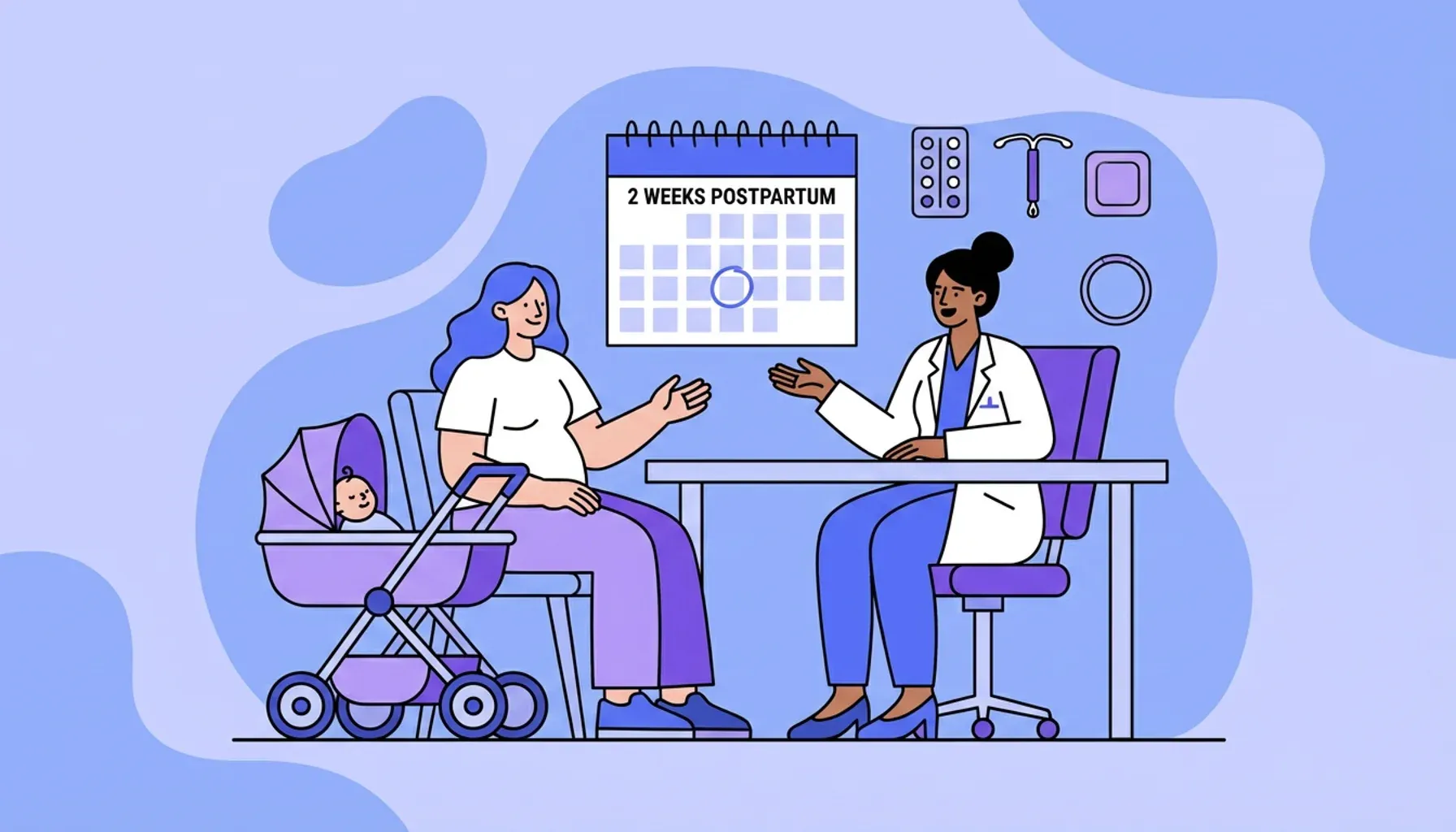
WHO recommends that doctors ask a woman about returning to sexual activity and discuss contraceptive options with her as early as two weeks after giving birth [2]. It is worth remembering that breastfeeding protects against a new pregnancy only if you exclusively breastfeed on demand [3].

If you had a vaginal birth

At this time, mothers may be disturbed by such annoying little things as urine leakage when coughing, laughing, and even during sex [1], as well as milk leaking between feedings. For both cases, there are special pads.

If you had a tear or an episiotomy during labor, it may still be painful to sit and go to the bathroom. Gradually, the pain will go away, but for now try to avoid constipation: drink more water, eat more fiber to avoid straining and increase stress on the scars [4].

If you had a cesarean section

Over the past decade, there has been a lot of research on the resumption of sexual activity after surgery. All of them came to the conclusion that the mode of delivery does not affect sexual activity. If the suture heals well, then women after cesarean return to sex as quickly as those who gave birth on their own. And perhaps faster than those who suffered a tear or episiotomy [5].


  1. Postpartum period: three distinct but continuous phases. Mattea Romano, et al. Journal of Prenatal Medicine, vol. 4, 2, 2010.

  2. WHO recommendations on maternal health: guidelines approved by the WHO Guidelines Review Committee. Geneva: World Health Organization, 2017 (WHO/MCA/17.10). Licence: CC BY-NC-SA 3.0 IGO. Р. 17.

  3. Contraceptive efficacy of lactational amenorrhoea. K. I. Kennedy, C. M. Visness. Lancet, 1992.

  4. Episiotomy. Royal College of Obstetricians and Gynaecologists, 2021.

  5. Impact of Mode of Delivery on Female Postpartum Sexual Functioning: Spontaneous Vaginal Delivery and Operative Vaginal Delivery vs. Cesarean Section. Giussy Barbara, Paola Pifarotti, et al. J Sex Med, Mar 2016.

Frequently asked questions

WHO recommends discussing contraceptive options with your doctor as early as two weeks after delivery. The timing depends on your individual recovery and the type of contraception chosen.

Breastfeeding only provides contraceptive protection if you exclusively breastfeed on demand without any supplementation. This method is not 100% reliable for preventing pregnancy.

Most healthcare providers recommend waiting at least 18-24 months between pregnancies to allow your body to fully recover. This spacing promotes healthy pregnancy outcomes for both mother and baby.

Yes, research shows that delivery method doesn't significantly affect sexual activity resumption. Women who had cesarean sections often return to sexual activity as quickly as those with vaginal births.

Progestin-only methods, barrier methods, and IUDs are generally safe during breastfeeding. Combined hormonal methods may affect milk supply and should be discussed with your healthcare provider.

Medical Disclaimer

This article is for informational purposes only and is not a substitute for professional medical advice, diagnosis, or treatment. Always seek the advice of your physician or qualified health provider with any questions you may have regarding a medical condition.

Meet our medical experts

Medically reviewed content

Reviewed by healthcare professionals · Updated September 4, 2024

Track your pregnancy on the go

Rated 4.8417,594 reviews