Baby’s sex is now visible!
By this time, your doctor can see your baby’s sex with ultrasound equipment [1].
 In baby girls, hundreds of thousands of eggs are already forming in their ovaries, which descend from the abdominal cavity into the pelvic region [2]. They now have a uterus, fallopian tubes, and a vagina.
In baby boys, the testes are still within the abdominal cavity, but the external genitalia has developed and looks as expected.
Your baby is growing stronger as their bones become firmer. The head is no longer pressed down against the chest, and arm and leg movements are more coordinated as they bend and straighten. When awake, your baby can tilt their body, grimace, squint, furrow their brow, and open and closes their mouth.
The eyes are in place and the ears will be too by the end of this week. Your baby has a clearly defined nose, eyelashes, eyebrows, and maybe even some hair on their head [1, 3].
All of the baby’s internal organs are functioning, and all bodily systems are fully functioning except for the respiratory system. Their heart rate is about 120-160 beats per minute, and the kidneys produce urine excreted every 45 minutes [1].
If you are expecting twins
By this time, doctors should have already clearly establish whether the babies share one placenta or if each has its own. If the placenta is shared, it is important to know whether the fetal sac is also shared, or whether each child is developing within its own enclosed space. Therefore, do not be surprised if you are asked to have several additional ultrasounds.
What we can see on an ultrasound
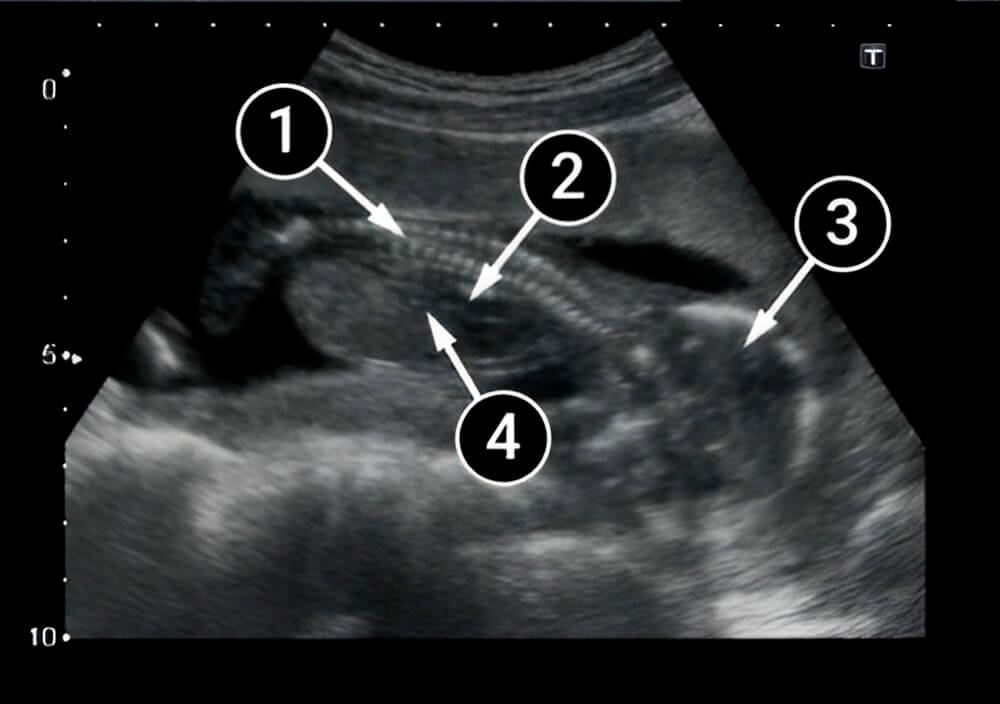
In this picture, you can see the baby lying on their back. The position lets you see the spine and ribs (clear, white, parallel lines).
The baby’s arms and legs are not visible here. You can see the chest, distinct from the abdominal cavity, and the intestines are visible within the abdomen. The thin, dark outline is the diaphragm, and you can see intercostal spaces between the ribs.