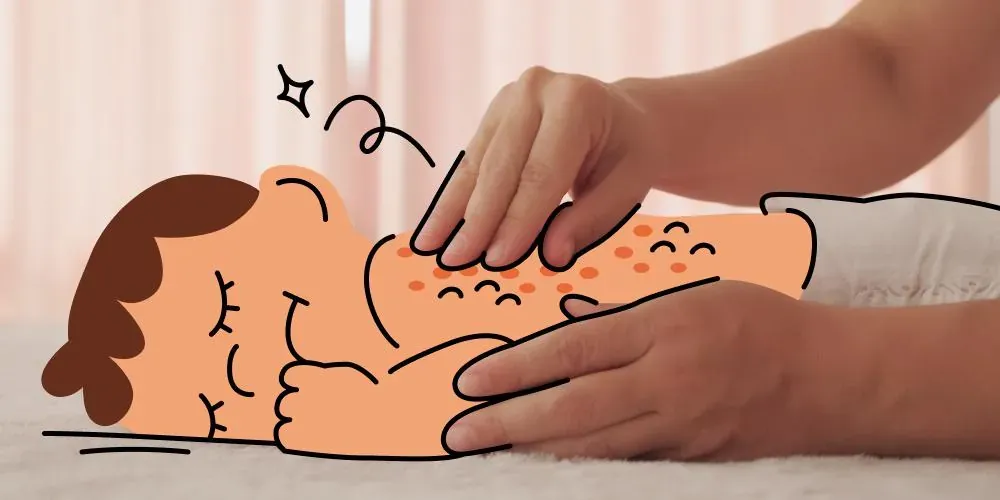

By about three months, many mothers notice that their babies' heads appear flat on the back or side. Most often, the back of the head is flattened, making the crown look disproportionately wide.
This is called brachycephaly. When the head is flat on one side and looks asymmetrical, it is called plagiocephaly.
What causes flat head syndrome?
Babies spend most of their time lying on their backs, a position recommended to reduce the risk of sudden infant death syndrome (SIDS) [1].
However, during the first three months, both the human brain and the skull grow quickly. Until the fontanelles close, the size and shape of the skull can change rapidly.
If the head is always in the same position, constant pressure at that point of contact can flatten the skull. If a baby lies directly on their back with their nose up, the back of the head may flatten.
If a baby sleeps with their head to one side (63% of cases to the right), the corresponding side can flatten while the other side enlarges to compensate.
By three months of age, almost half of babies' skulls are slightly deformed [2].
Is this dangerous?
It depends on the degree of deformation. In most cases, it's a purely cosmetic issue that can improve with age. However, one study found that moderate and severe flat head syndrome may be associated with developmental delays [3].
Does this mean that baby should not sleep on their back all the time?
Since sleeping on their back is the safest position in terms of SIDS, babies should continue to sleep on their backs [1]. However, you can adjust their position while they are awake.
Tummy time: Encourage your baby to lift their head. If it is difficult, roll up a towel and place it under their armpits. If the baby falls asleep, turn them on their back.
Change positions: Babies frequently turn their heads toward you. Change their position in the crib so that they continue to look at you while resting their head in a new position.
Move toys: Place toys on the side your baby doesn’t usually look at. If they look left more often, place toys on the right, and vice versa.
Use a carrier: Wearing your baby in a carrier can help reduce time spent lying on their back.
Limit time in car seats: Try to minimize time in car seats and stroller seats, as these can also contribute to skull deformation [4].
If plagiocephaly and brachycephaly are present, what can be done?
While the anterior fontanelle is still open, the skull is still growing. Orthopedic helmets can help reshape baby’s head. Research shows that the chances of success are much greater between the ages of three and six months than between eight and twelve months [4].
Visit your doctor as soon as you notice your baby’s head appears flattened.
Photo: shutterstock