
Almost any question regarding your baby’s health is worth discussing with your pediatrician. It's much better to ask than to risk missing something that may need attention. Here are some symptoms that may not be as harmless as they seem:
Red cheeks
This may be the first sign of atopic dermatitis. Later, the skin may itch, hurt, peel, and crack. Environmental factors such as dry air, hard water, and frequent washing can trigger a flare-up [1]. But often, genetic predisposition is to blame [2].
Diaper rash
Diaper dermatitis (the medical term for diaper rash) is a common problem. If caught on time, when redness and rashes are limited to the folds of your baby’s skin, you can likely handle it yourself. But if the entire buttocks are red and you notice a rash or cracks in the folds of the skin, it’s time to see a doctor. They will prescribe special ointments to stop the development of infection [3].
Heat rash
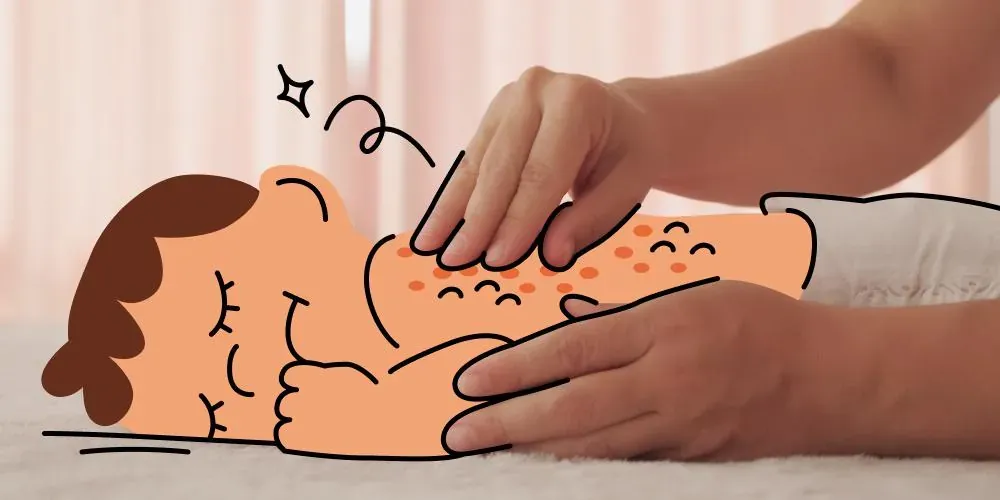
This type of rash looks like small pimples on irritated skin and often shows on the neck, armpits, and groin. Unlike atopic dermatitis, heat rash usually develops in humid, rather than dry conditions, and is a direct result of overheating [4]. The best way to prevent and treat heat rash is by dressing your baby in minimal, breathable clothing. If the pimples start to burst, see a doctor, as they can get infected and complicate the issue.
Yellow scabs
The condition known as impetigo most often appears as yellow scabs near the nose and mouth, on the hands, and in skin folds. The scabs resemble the cradle cap on newborn babies’ heads but can become inflamed and itchy. The condition is highly contagious, your doctor will most likely prescribe antibiotics to treat it [5].
Hair on the body
At birth, many babies are covered in a fine, fluffy hair called lanugo, which disappears within a few months. But if you notice that it spreads over the body or that the hair becomes coarser and darker, be sure to tell your doctor. Hypertrichosis (abundant hair growth) in infants is not just a cosmetic concern, it might be a sign of a genetic disorder that should be diagnosed [6].